EPISODE 5-Biophilic Organic and Couture Christmas: 2 Calming Alternatives to Festive Maximalism for 2026
Discover Biophilic Organic and Couture Christmas trends for 2026: calming cedar, eucalyptus, flocked White Forest trees, Scandi stars & luxury restraint.
 🔍 COVER PLATE — CLICK TO EXPAND
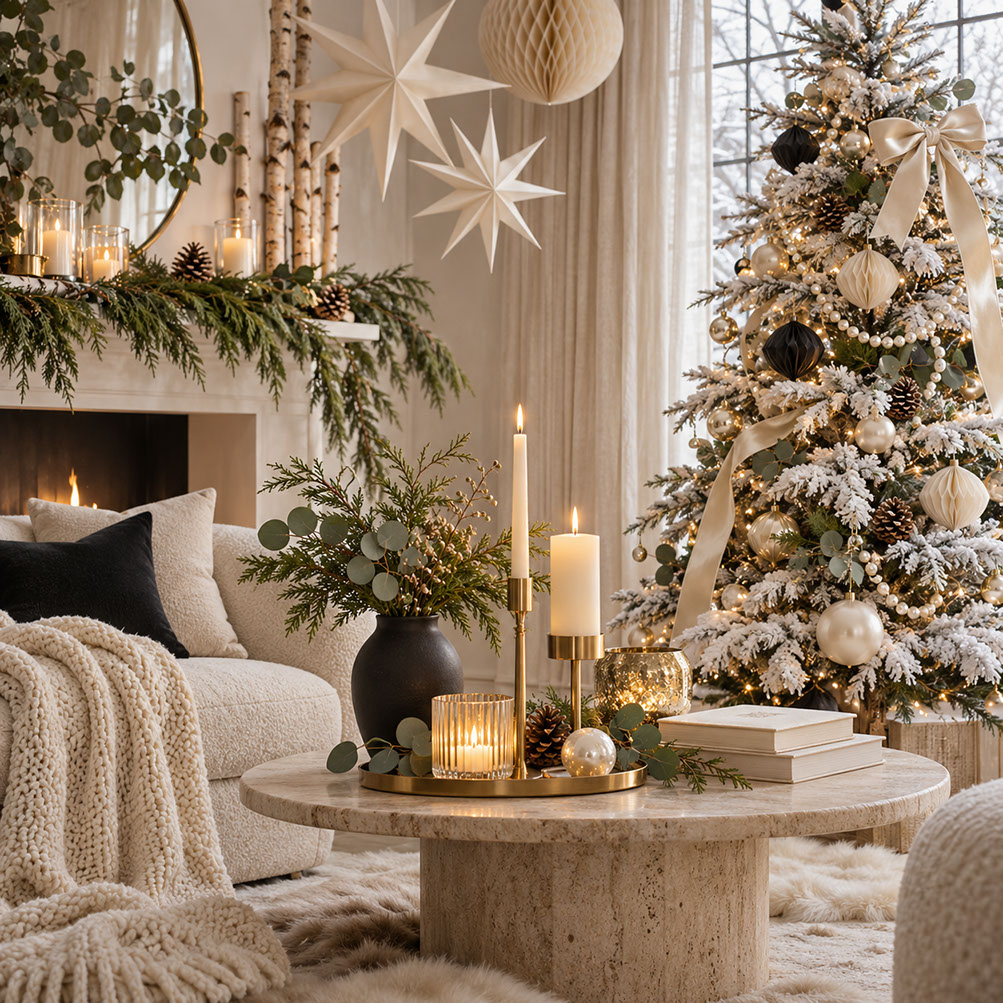
Editorial hero cover for Episode 5 ('Biophilic Organic and Couture Christmas: 2 Calming Alternatives to Festive Maximalism for 2026'): a serene living room uniting Biophilic Organic elements—fresh cedar and silver-dollar eucalyptus garlands, birch logs, pinecones, and glowing pillar candles on a travertine coffee table—with Couture Christmas refinement, including a snow-flocked tree dressed in champagne satin ribbon, black and ivory pleated paper ornaments, pearl garlands, and suspended Scandinavian paper stars above a cream bouclé armchair.
Not every home suits tinsel abundance and colour saturation, and that's absolutely okay. If the thought of disco balls, lametta, and quirky pop-culture baubles leaves you feeling slightly overwhelmed rather than festively inspired, you're certainly not alone. For 2026, there are equally valid and genuinely beautiful directions for those seeking restraint, calm, and sophisticated simplicity during the festive season.
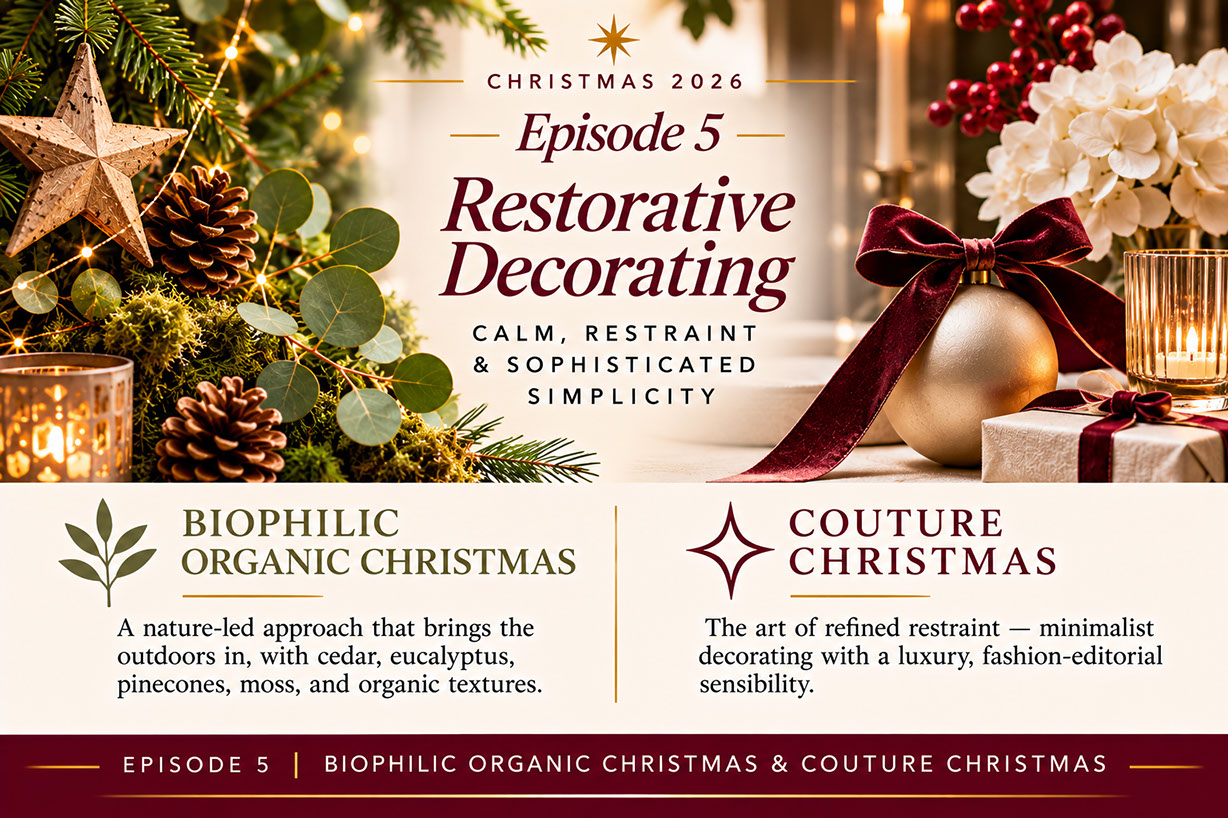
Think of this as 'restorative decorating'—festive schemes designed to calm rather than overwhelm, creating spaces that feel like a gentle exhale rather than a visual shout. Today, we're exploring two distinct aesthetic directions that offer thoughtful counterpoints to maximalism: Biophilic Organic Christmas, which connects your home to the natural world, and Couture Christmas, which elevates minimalist restraint to a luxury statement.
 🔍 PLATE 01 — CLICK TO EXPAND
Restorative Decorating — Biophilic Organic Christmas vs. Couture Christmas Overview — Introduction to Episode 5's 'Restorative Decorating' philosophy—calm, restraint, and sophisticated simplicity designed to feel like a gentle exhale: comparing Biophilic Organic Christmas (a nature-led approach bringing the outdoors in with cedar, eucalyptus, pinecones, moss, birch bark stars, and warm candlelight) alongside Couture Christmas (the art of refined restraint and minimalist fashion-editorial luxury with matte champagne baubles, deep velvet bows, and fluted glass candleholders). Colour Palette: Woodland Cedar (#2E4A2E), Eucalyptus Leaf (#6B8264), Couture Burgundy (#54121B), Matte Champagne (#D4B886), Soft Parchment (#F5EFE6)
Understanding Biophilic Organic Christmas
 🔍 PLATE 02 — CLICK TO EXPAND
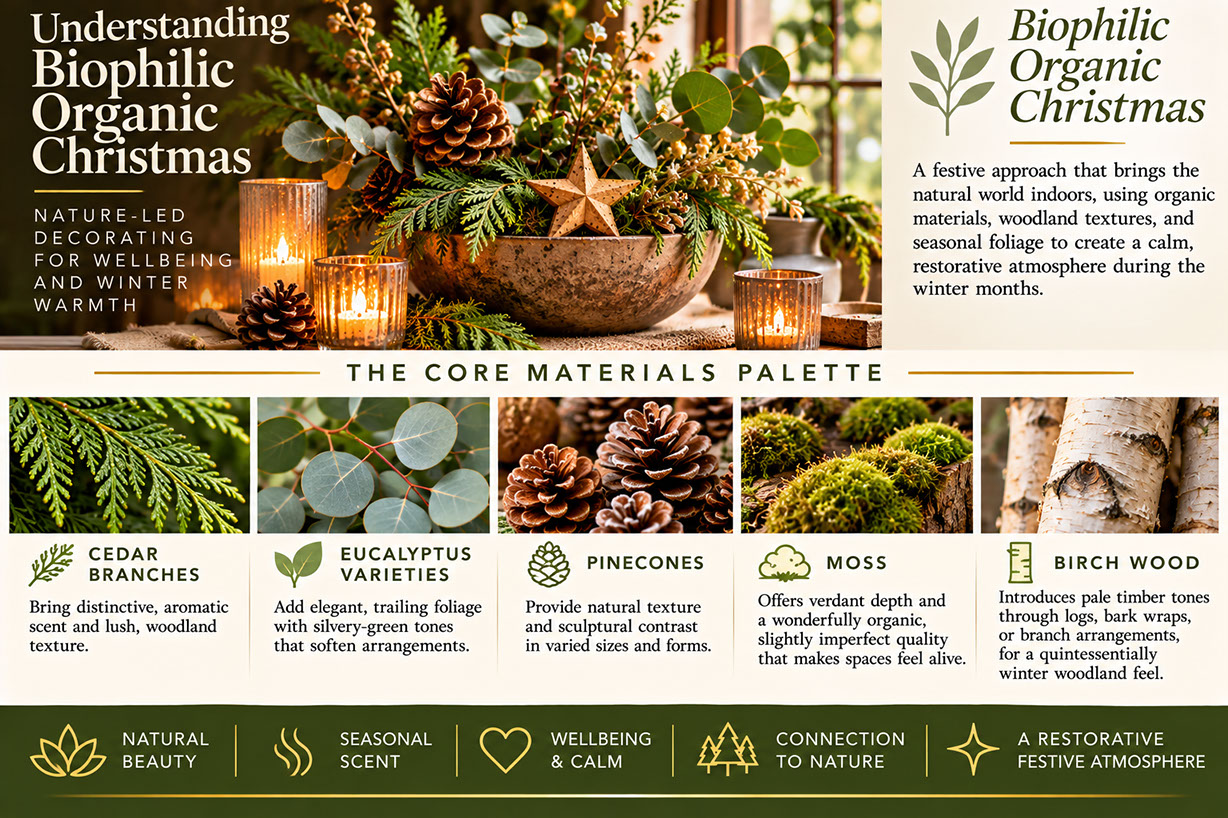
Understanding Biophilic Organic Christmas — The Core Materials Palette: Cedar, Eucalyptus, Pinecones, Moss & Birch — Complete materials dossier for 'Understanding Biophilic Organic Christmas': featuring a rustic stoneware bowl centrepiece filled with fresh conifer, silver-dollar eucalyptus, pinecones, and a birch-bark star flanked by fluted glass candles, accompanied by the five foundational elements of The Core Materials Palette—(1) Cedar Branches for aromatic woodland scent, (2) Eucalyptus Varieties for silvery-green trailing foliage, (3) Pinecones for sculptural contrast, (4) Moss for verdant depth, and (5) Birch Wood for pale winter woodland timber tones. Colour Palette: Cedar Green (#2D4F25), Silver Eucalyptus (#7A917E), Pinecone Umber (#5C3A21), Verdant Moss (#5A7328), Birch Bark White (#E5DEC9)
Biophilic design has been transforming interior spaces for several years now, and its principles translate beautifully into festive decoration. At its core, biophilic design involves incorporating natural elements to promote wellbeing—something particularly valuable during the darker winter months when we're naturally craving connection to the outdoors.
The Core Materials Palette
The foundation of Biophilic Organic Christmas lies in its carefully curated materials palette. Cedar branches bring their distinctive aromatic contribution, filling your home with that unmistakable fresh woodland scent. Eucalyptus varieties—whether silver dollar, seeded, or willow—add elegant trailing foliage with silvery-green tones that soften any arrangement.
Pinecones in varied sizes and natural states provide textural contrast, whilst moss offers verdant depth and that wonderfully organic, slightly imperfect quality that makes spaces feel alive. Birch wood, whether as logs, bark wraps, or branch arrangements, introduces pale timber tones that feel quintessentially winter woodland.
Fresh Versus Faux Foliage Considerations
 🔍 PLATE 03 — CLICK TO EXPAND
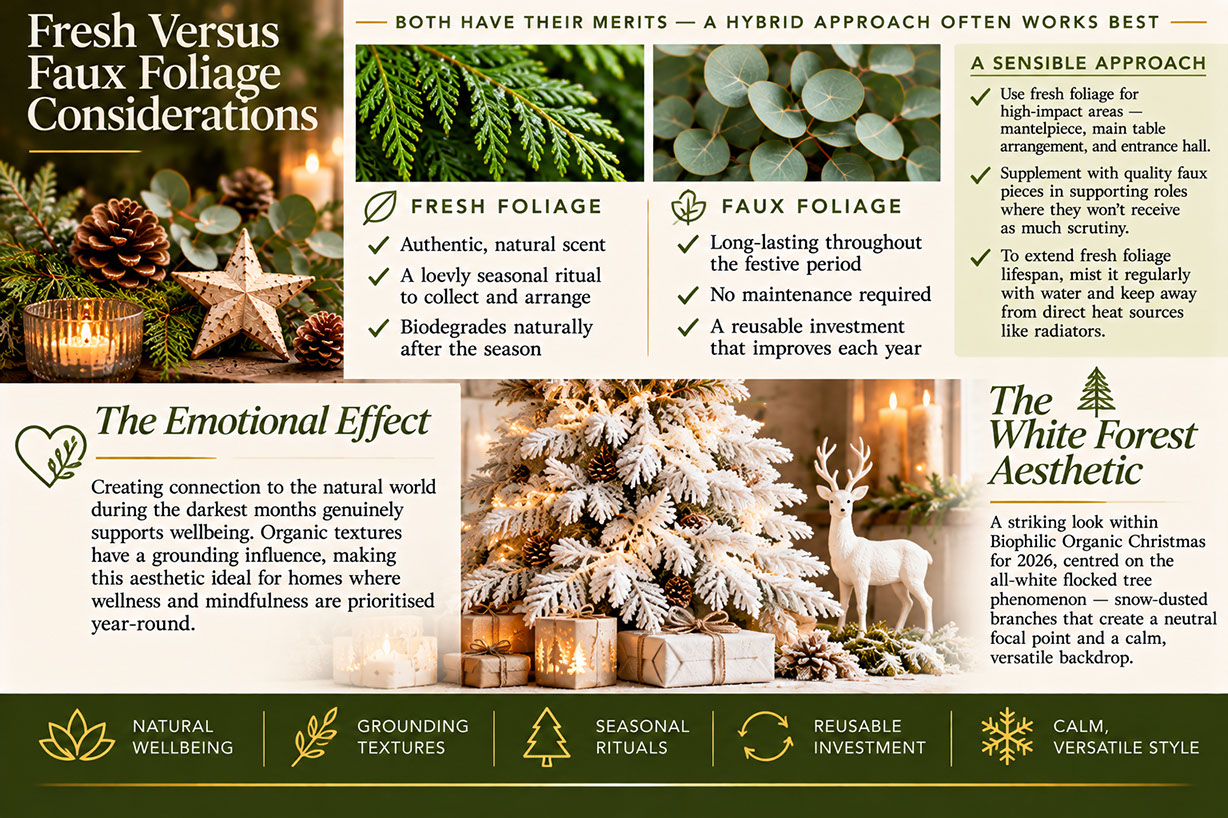
Fresh vs. Faux Foliage Considerations, The Emotional Effect & Introduction to The White Forest Aesthetic — Visual guide to 'Fresh Versus Faux Foliage Considerations', 'The Emotional Effect', and 'The White Forest Aesthetic': outlining a sensible hybrid foliage strategy (using aromatic fresh cedar and eucalyptus on high-impact mantelpieces, main tables, and entrance halls while supplementing with reusable faux foliage in supporting areas), explaining how organic textures support winter wellbeing and mindfulness, and introducing the snow-dusted all-white flocked tree look. Colour Palette: Snow Flocked White (#F2EFE9), Fresh Conifer (#2A4B24), Silvery Sage (#7B907D), Kraft Linen (#C8B294), Candlelight Gold (#E8B968)
One question that comes up repeatedly is whether to choose fresh or faux foliage. Honestly, both have their merits, and a hybrid approach often works best.
Fresh foliage offers authentic scent, creates a lovely seasonal ritual when you collect and arrange it, and biodegrades naturally after the season ends. There's something genuinely special about the real thing. However, faux foliage provides longevity throughout the festive period, requires no maintenance, and represents a reusable investment that improves with each passing year.
A sensible approach? Use fresh foliage for high-impact areas where you'll notice and appreciate the scent—your mantelpiece, your main table arrangement, your entrance hall. Then supplement with quality faux pieces in supporting roles where they won't receive as much scrutiny. To extend fresh foliage lifespan, mist it regularly with water and keep arrangements away from direct heat sources like radiators.
The Emotional Effect
The psychological benefits of Biophilic Organic Christmas shouldn't be underestimated. Creating connection to the natural world during the darkest months genuinely supports wellbeing. Organic textures have a grounding influence, and this aesthetic particularly suits homes where wellness and mindfulness are prioritised year-round.
The White Forest Aesthetic
Within Biophilic Organic Christmas, the White Forest aesthetic has gained significant popularity for 2026. This approach centres on the all-white flocked tree phenomenon—those snow-dusted branches creating a neutral focal point that serves as backdrop rather than statement.
Styling the Flocked Tree
 🔍 PLATE 04 — CLICK TO EXPAND
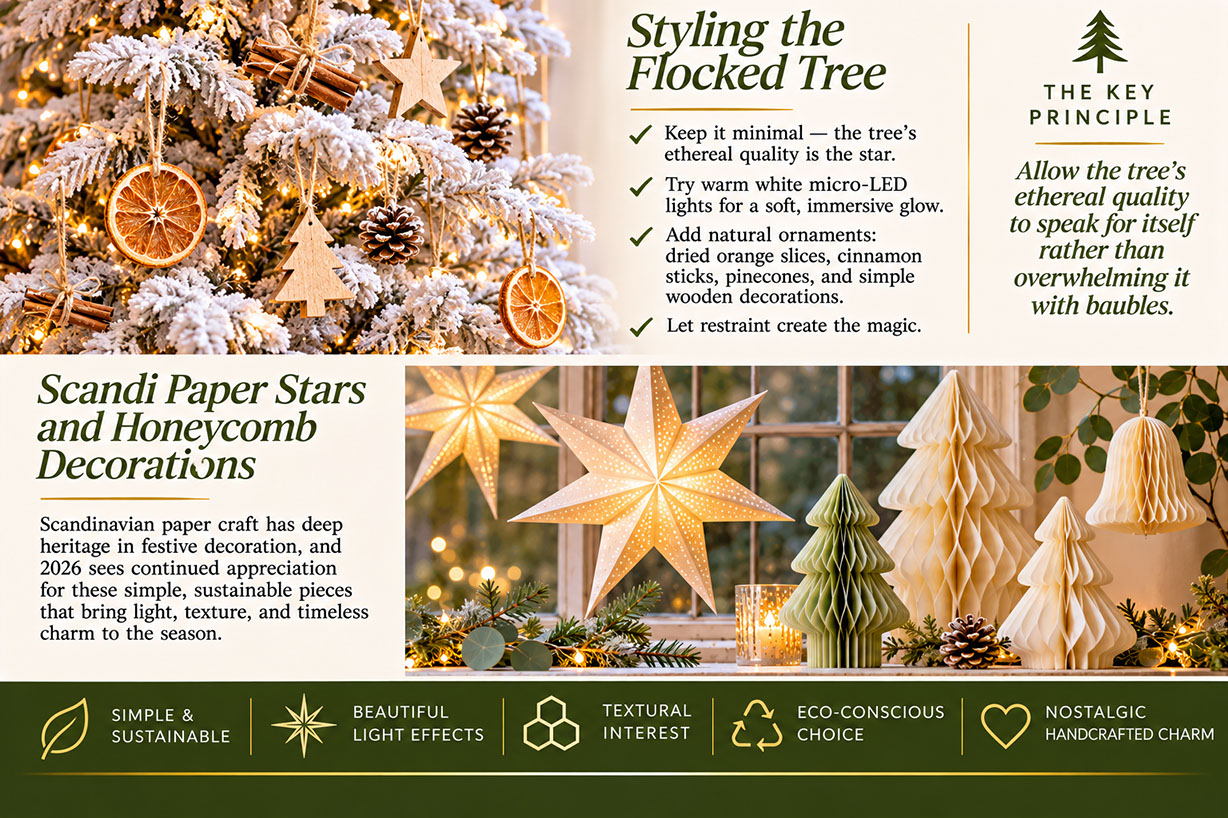
Styling the Flocked Tree & Scandi Paper Stars and Honeycomb Decorations — Detailed styling guide for 'Styling the Flocked Tree' and 'Scandi Paper Stars and Honeycomb Decorations': top panel shows a snow-flocked tree dressed with warm white micro-LED lights, dried orange slices, cinnamon stick bundles, pinecones, and raw timber tree cut-outs; bottom panel showcases illuminated perforated Scandinavian paper stars and pleated honeycomb paper trees and bells in cream, white, and sage green. Colour Palette: Dried Orange Amber (#D46A1E), Cinnamon Bark (#7A4322), Honeycomb Cream (#EDE5D4), Scandi Sage (#788664), Flocked Snow (#F5F3EE)
White flocked trees work beautifully with minimal decoration—sometimes just warm white micro-LED lights wrapped tightly around branches are enough. Alternatively, you might add carefully curated natural ornaments: dried orange slices, cinnamon sticks, small pinecones, and simple wooden decorations in raw timber tones.
The key is restraint. Allow the tree's ethereal quality to speak for itself rather than overwhelming it with baubles.
Scandi Paper Stars and Honeycomb Decorations
Scandinavian paper craft has deep heritage in festive decoration, and 2026 sees continued appreciation for these simple, sustainable pieces. Scandi paper stars in various sizes create beautiful lighting effects when illuminated from behind, casting geometric shadows that transform throughout the day.
Honeycomb paper trees and bells add textural alternatives in muted cream, white, and soft sage tones. The sustainability appeal of paper-based decorations resonates strongly with contemporary values, and there's something wonderfully nostalgic about their gentle, handcrafted quality.
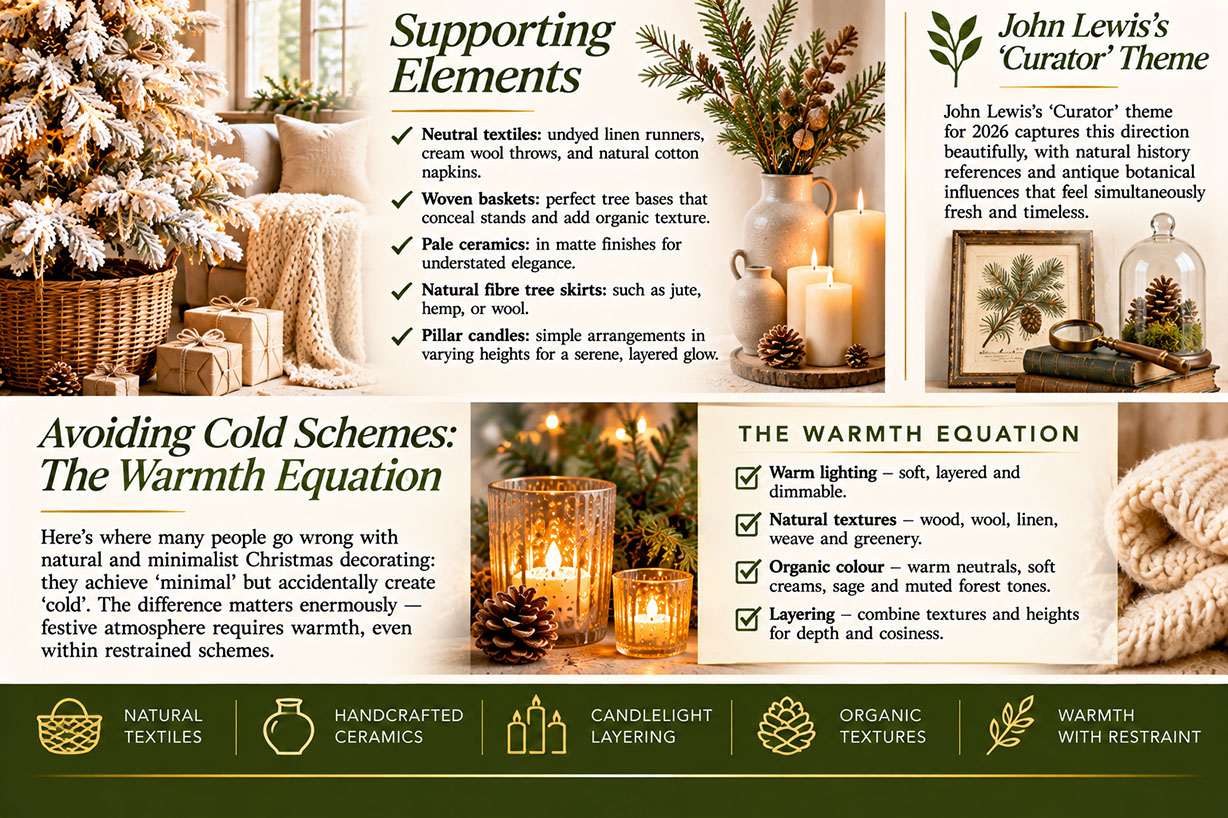
Supporting Elements
 🔍 PLATE 05 — CLICK TO EXPAND
White Forest Supporting Elements, John Lewis's 'Curator' Theme & Avoiding Cold Schemes: The Warmth Equation — Editorial breakdown of 'Supporting Elements', John Lewis's 2026 'Curator' theme, and 'Avoiding Cold Schemes: The Warmth Equation': showcasing a flocked tree in a woven wicker basket beside chunky cream wool throws, matte stoneware ceramics with pillar candles, an antique botanical print and pinecone glass cloche with brass magnifying glass, and the four pillars of The Warmth Equation (Warm Lighting, Natural Textures, Organic Colour, and Layering). Colour Palette: Woven Wicker (#9C6B3B), Matte Stoneware (#D8CEC0), Botanical Pine (#324B2E), Knitted Cream (#EFE8DC), Fluted Amber Glow (#EAA84C)
To complete the White Forest look, consider neutral textiles: undyed linen runners, cream wool throws draped over furniture, and natural cotton napkins for your table. Woven baskets work beautifully as tree bases, concealing stands whilst adding organic texture. Pale ceramics in matte finishes, natural fibre tree skirts, and simple arrangements of pillar candles in varying heights round out this serene aesthetic.
John Lewis's 'Curator' theme for 2026 captures this direction beautifully, with natural history references and antique botanical influences that feel simultaneously fresh and timeless.
Avoiding Cold Schemes: The Warmth Equation
 🔍 PLATE 06 — CLICK TO EXPAND
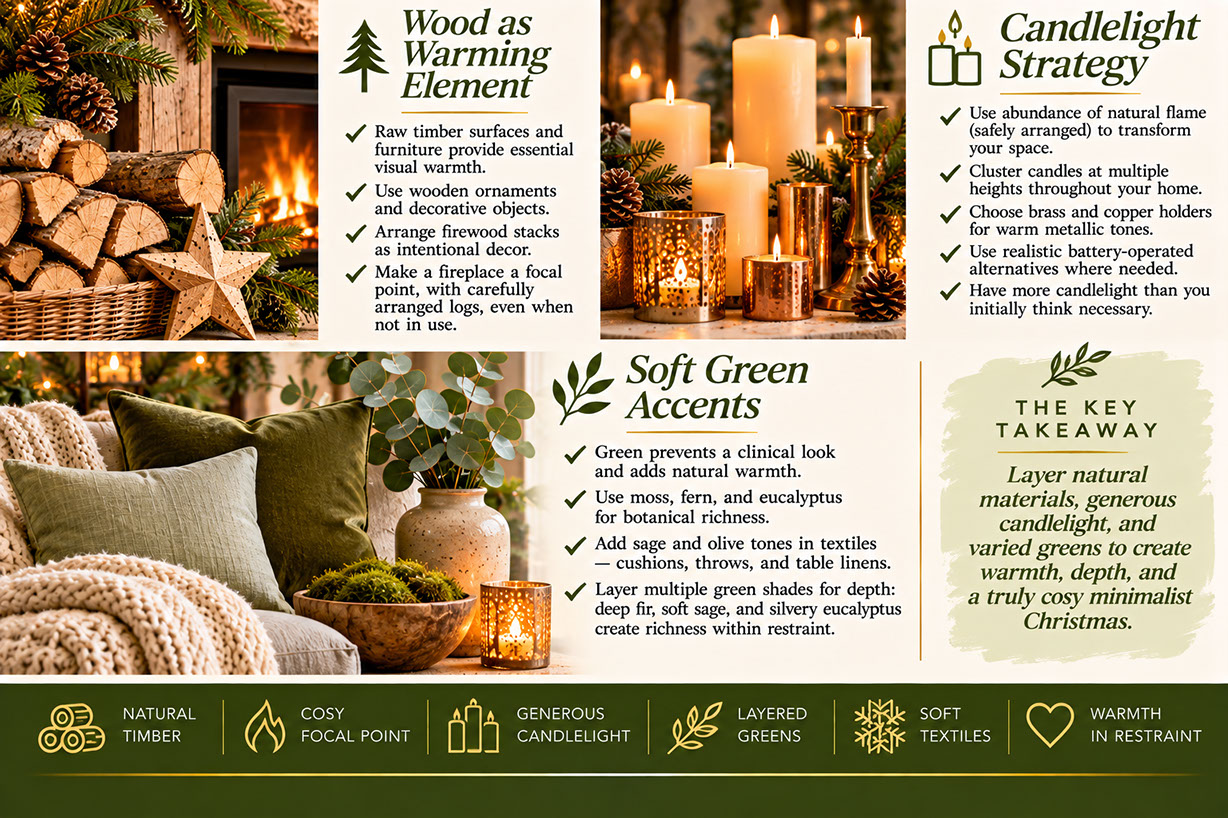
The Warmth Equation in Practice — Wood as Warming Element, Candlelight Strategy & Soft Green Accents — Three-pillar guide to preventing minimal Christmas schemes from feeling cold: (1) Wood as Warming Element (raw timber surfaces, wooden star ornaments, and intentional firewood stacks beside the hearth), (2) Candlelight Strategy (clustering pillar and taper candles at multiple heights in warm brass and copper holders), and (3) Soft Green Accents (layering moss bowls, silver-dollar eucalyptus in stoneware vases, and sage and olive velvet and linen cushions). Colour Palette: Split Firewood Birch (#B88352), Hammered Copper (#B86B38), Olive Velvet (#4A5628), Soft Sage Linen (#9BA68B), Hearth Flame (#F29E38)
Here's where many people go wrong with natural and minimalist Christmas decorating: they achieve 'minimal' but accidentally create 'cold'. The difference matters enormously—festive atmosphere requires warmth, even within restrained schemes.
Wood as Warming Element
Raw timber surfaces and furniture provide essential visual warmth. Wooden ornaments, decorative objects, and firewood stacks arranged as intentional decor rather than mere fuel storage all contribute to this warming effect. If you have a fireplace, make it a focal point with carefully arranged logs even when not in use.
Candlelight Strategy
Abundance of natural flame (safely arranged, obviously) transforms any minimal scheme. Cluster candles at multiple heights throughout your space, using brass and copper candle holders that add warm metallic tones without introducing shine that feels cold. For practical locations—near curtains, in children's bedrooms, or anywhere safety is a concern—battery-operated alternatives now look remarkably realistic.
The key is having more candlelight than you initially think necessary. Underestimating candle quantities is the most common mistake in cosy minimal decorating.
Soft Green Accents
Green prevents clinical appearance more effectively than almost any other element. Moss, fern, and eucalyptus provide warming botanical elements, whilst sage and olive tones in textiles—cushion covers, throws, table linens—add softness without introducing colour that feels jarring.
Layer multiple green shades rather than sticking to one tone. Depth comes from variety: deep fir alongside pale sage alongside silvery eucalyptus creates richness within restraint.
Couture Christmas Defined
 🔍 PLATE 07 — CLICK TO EXPAND
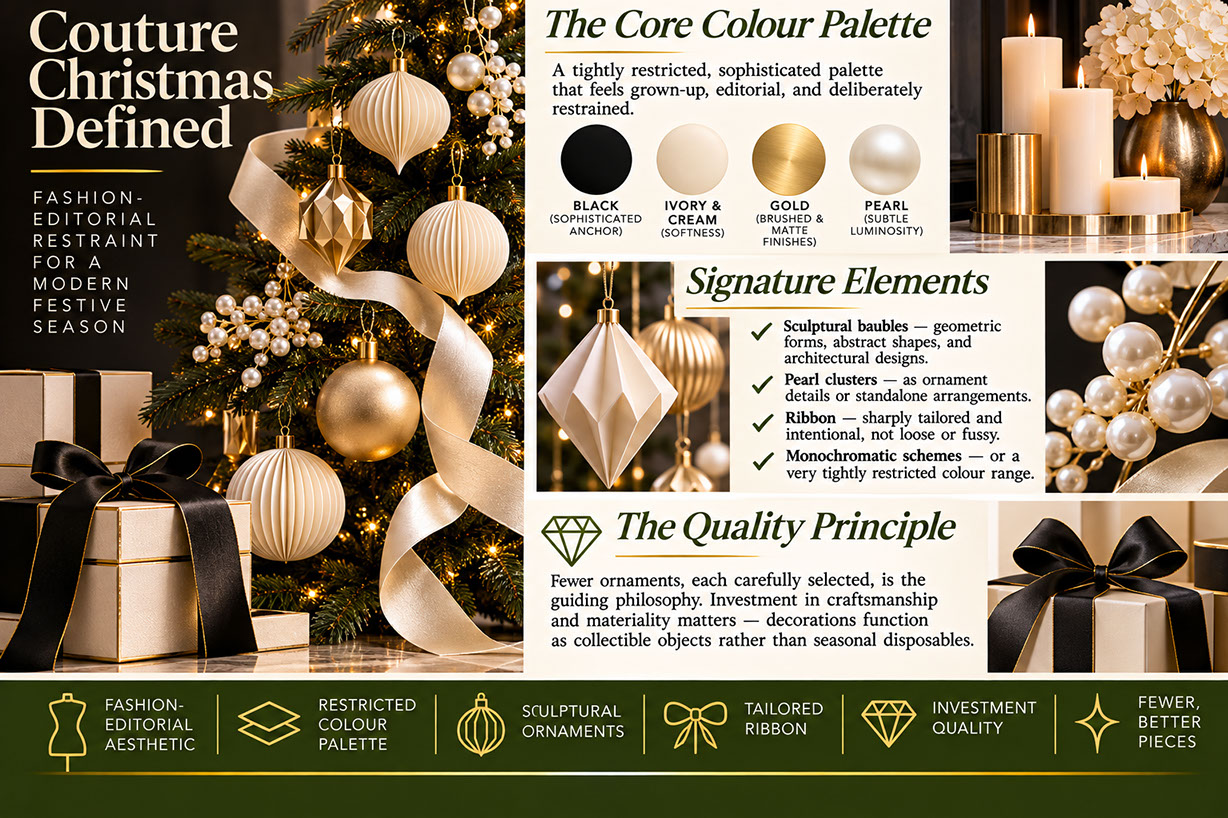
Couture Christmas Defined — The Core Colour Palette (Black, Ivory, Gold & Pearl), Signature Elements & The Quality Principle — Fashion-editorial dossier for 'Couture Christmas Defined': illustrating The Core Colour Palette of four tightly restricted tones—Black (sophisticated anchor), Ivory & Cream (softness), Brushed & Matte Gold, and Pearl (subtle luminosity)—alongside Signature Elements (sculptural geometric baubles, pearl cluster picks, sharply tailored satin ribbons, and monochromatic gift wrapping) and The Quality Principle ('fewer, better pieces' selected as collectible design objects). Colour Palette: Couture Onyx (#141414), Soft Ivory (#EDE6D8), Brushed Gold (#C5A358), Luminous Pearl (#E6E1D8), Deep Forest Accent (#24381E)
If Biophilic Organic Christmas is nature-led calm, Couture Christmas represents fashion-editorial restraint—the most pared-back festive option for 2026. This aesthetic draws inspiration from fashion photography and high-end editorial styling, treating festive decoration with the same precision applied to a Vogue photoshoot.
The Core Colour Palette
Couture Christmas works within a tightly restricted palette: black as sophisticated anchor, ivory and cream providing softness, gold in brushed and matte finishes (avoiding bright shine that reads as cheap), and pearl tones adding subtle luminosity without sparkle.
This palette feels grown-up, editorial, and deliberately restrained. It's Christmas for people who find traditional festive colours slightly overwhelming.
Signature Elements
Sculptural baubles define Couture Christmas—geometric forms, abstract shapes, and architectural ornaments that function as design objects rather than merely decorations. Pearl clusters feature prominently, whether as ornament details or standalone arrangements.
Ribbon, when used, appears in sharply tailored arrangements rather than loose bows. Think neat, intentional, controlled. Monochromatic or very tightly restricted colour schemes are essential—this aesthetic doesn't work with variety.
The Quality Principle
Fewer ornaments, each carefully selected, is the guiding philosophy. Investment in craftsmanship and materiality matters here—decorations function as collectible objects rather than seasonal disposables. Think of it as the Marie Kondo approach to festive decorating: each piece must earn its place.
Styling Couture Christmas Successfully
 🔍 PLATE 08 — CLICK TO EXPAND
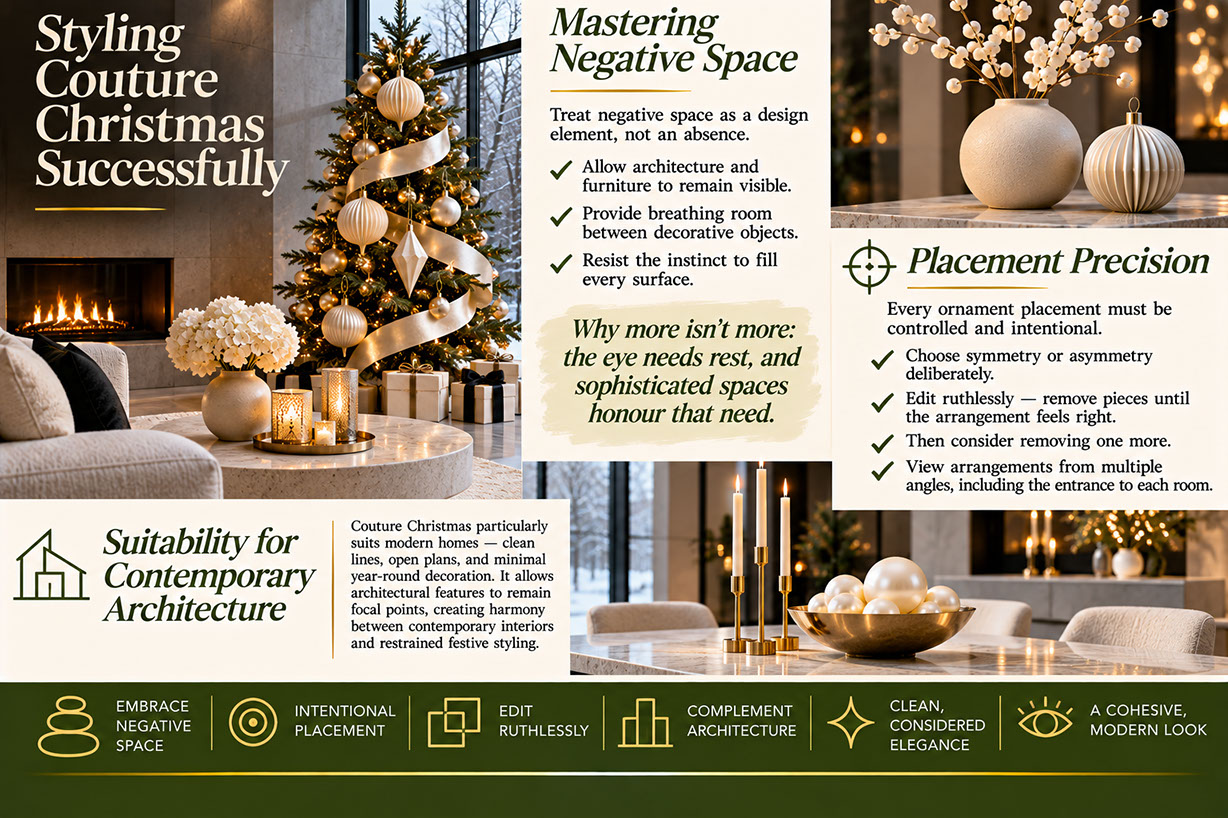
Styling Couture Christmas Successfully — Mastering Negative Space, Placement Precision & Contemporary Architecture — Interior styling guide for 'Styling Couture Christmas Successfully': demonstrating (1) Mastering Negative Space (treating breathing room and visible architecture as deliberate design elements where 'more isn't more'), (2) Placement Precision (editing arrangements ruthlessly and checking sightlines from room entrances), and (3) Suitability for Contemporary Architecture (harmonising floor-to-ceiling black steel windows, concrete hearths, travertine tables, and brass taper holders with oversized pearl spheres). Colour Palette: Architectural Concrete (#8E8A83), Travertine Cream (#DDD4C5), Matte Black (#1C1B1A), Brushed Brass (#C49E50), Pearl White (#F4F0E8)
Mastering Negative Space
The key to Couture Christmas lies in understanding negative space as design element rather than absence. Allow architecture and furniture to remain visible. Provide breathing room between decorative objects. Resist the instinct to fill every surface.
Why more isn't more in this aesthetic: the eye needs rest, and sophisticated spaces honour that need.
Placement Precision
Every ornament placement must be controlled and intentional. Whether you choose symmetry or asymmetry, make it a deliberate choice rather than accident. Edit ruthlessly—remove pieces until the arrangement feels right, then consider removing one more.
View your arrangements from multiple angles, including the entrance to each room. How do they read at first glance?
Suitability for Contemporary Architecture
Couture Christmas particularly suits modern homes—clean lines, open plans, and minimal year-round decoration. This aesthetic allows architectural features to remain focal points, creating harmony between contemporary interiors and restrained festive styling rather than jarring contrast.
If your home features floor-to-ceiling windows, concrete elements, or architectural statement lighting, Couture Christmas will feel like natural extension rather than imposition.
Choosing Your Direction: Home and Lifestyle Considerations
 🔍 PLATE 09 — CLICK TO EXPAND
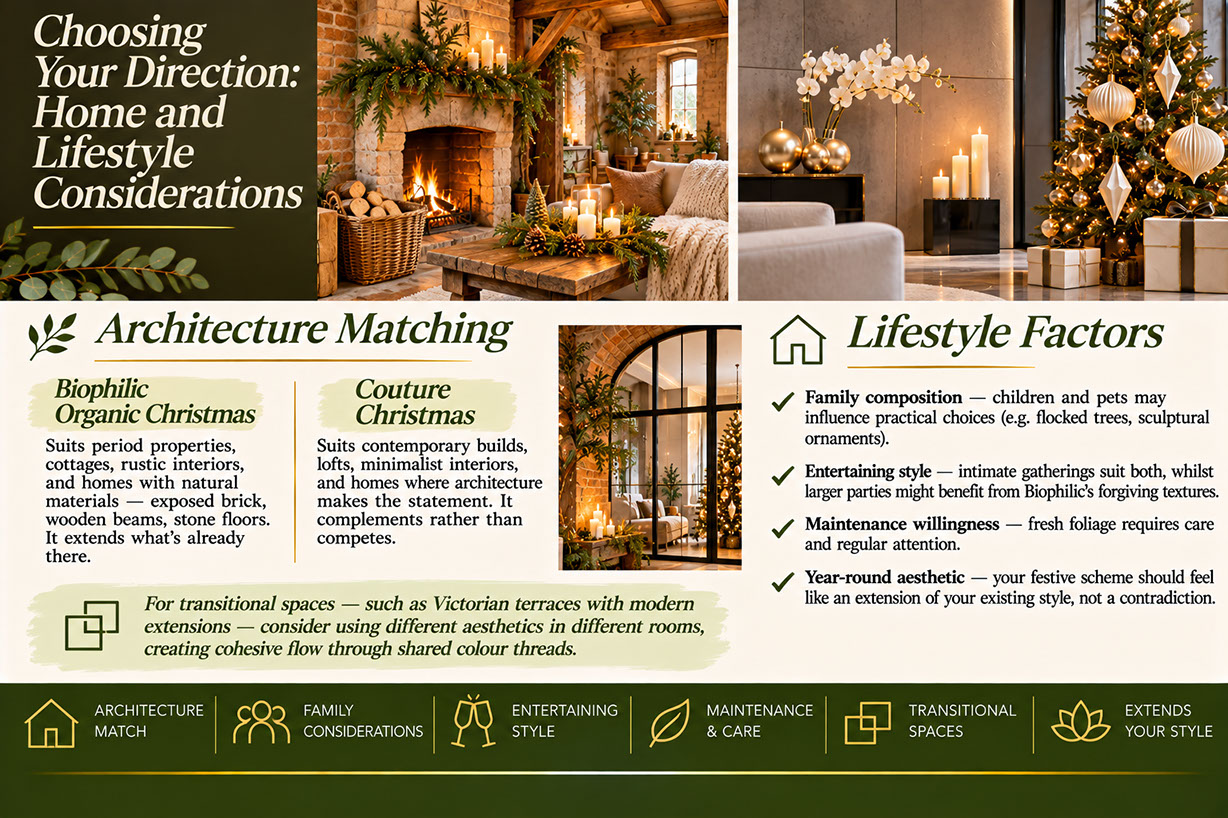
Home Architecture Matching (Period vs. Modern) & Lifestyle Considerations — Decision framework for 'Choosing Your Direction: Home and Lifestyle Considerations': comparing Architecture Matching—Biophilic Organic Christmas for period properties, cottages, exposed brick fireplaces, and timber beams versus Couture Christmas for contemporary builds, lofts, and minimalist interiors (plus bridging Victorian terraces and modern Crittall extensions via shared colour threads)—alongside four Lifestyle Factors (Family Composition, Entertaining Style, Maintenance Willingness, and Year-Round Aesthetic). Colour Palette: Exposed Heritage Brick (#9E5234), Oak Beam Timber (#784B2A), Architectural Taupe (#968D82), Champagne Glow (#E6B96E), Forest Foliage (#2A4426)
Architecture Matching
Biophilic Organic Christmas suits period properties, cottages, rustic interiors, and homes with existing natural materials—exposed brick, wooden beams, stone floors. It extends what's already there rather than introducing contradiction.
Couture Christmas suits contemporary builds, loft conversions, minimalist interiors, and homes where architecture itself makes the statement. It complements rather than competes.
For transitional spaces—Victorian terraces with modern extensions, for instance—consider using different aesthetics in different rooms, creating cohesive flow through shared colour threads.
Lifestyle Factors
Family composition matters: children and pets may influence whether white flocked trees and sculptural ornaments feel practical. Entertaining style matters too—intimate gatherings suit both aesthetics, but larger parties might benefit from Biophilic's forgiving textures.
Consider maintenance willingness (fresh foliage requires care) and your year-round aesthetic. Festive decoration should feel like extension of your existing style, not contradiction of it.
Conclusion
 🔍 PLATE 10 — CLICK TO EXPAND
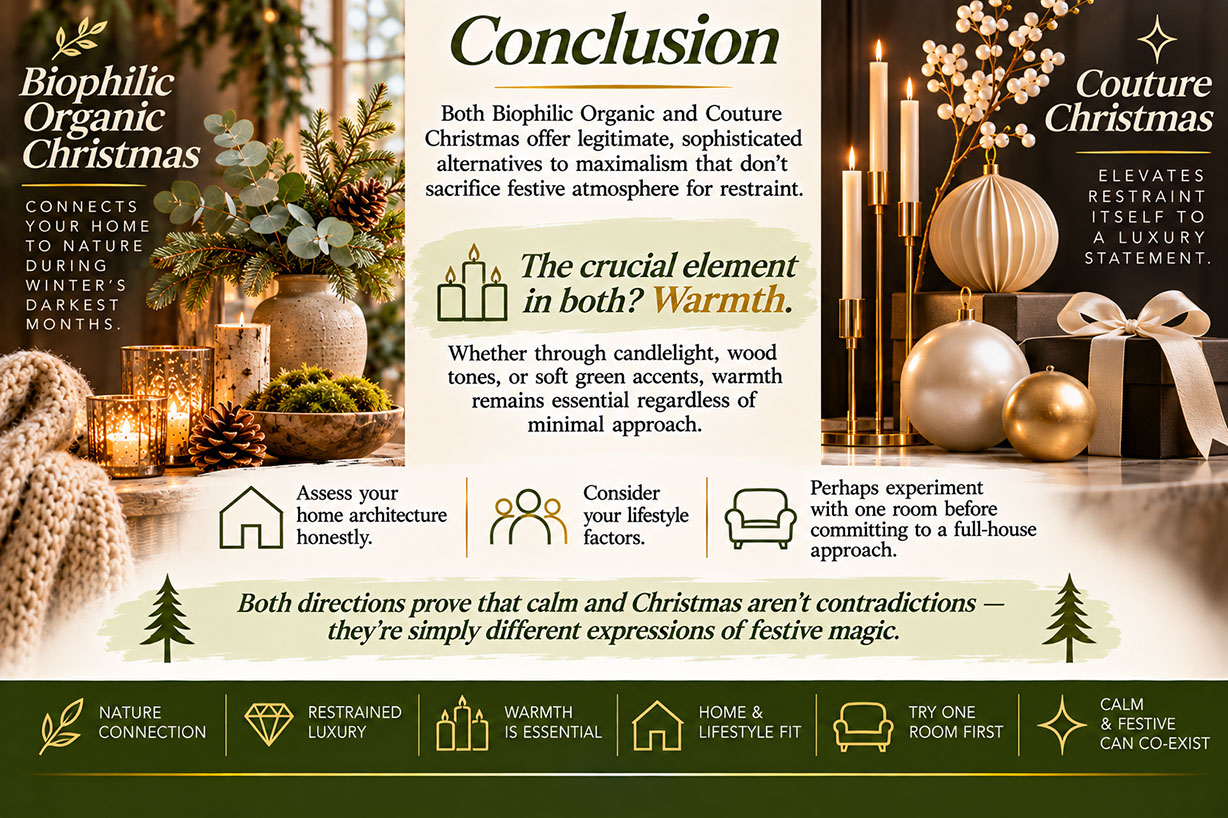
Biophilic Organic & Couture Christmas — Why Warmth Is the Crucial Element in Restrained Festive Styling — Closing synthesis for Episode 5 ('Conclusion: Both Directions Prove That Calm and Christmas Aren't Contradictions'): pairing Biophilic Organic Christmas (eucalyptus, pinecones, moss, birch candles, and chunky knit throws connecting your home to nature) with Couture Christmas (brass taper candlesticks, pleated ivory baubles, pearl spheres, and black-and-ivory gift boxes elevating restraint to luxury), united by the single crucial element in both: Warmth. Colour Palette: Woodland Moss (#4B612C), Candlelight Amber (#E8A642), Couture Black (#1B1A18), Satin Ivory (#EFE9DD), Brushed Gold (#C7A156)
Both Biophilic Organic and Couture Christmas offer legitimate, sophisticated alternatives to maximalism that don't sacrifice festive atmosphere for restraint. Biophilic Organic connects your home to nature during winter's darkest months, whilst Couture Christmas elevates restraint itself to luxury statement.
The crucial element in both? Warmth. Whether through candlelight, wood tones, or soft green accents, warmth remains essential regardless of minimal approach.
Assess your home architecture honestly, consider your lifestyle factors, and perhaps experiment with one room before committing to a full-house approach. Both directions prove that calm and Christmas aren't contradictions—they're simply different expressions of festive magic.
⚡ 5 Strategies to Consider
STUDIO PLAYBOOK // 5 DIRECTIVES❓ Frequently Asked Questions — 5 Q&As (5 Q&As)
SCHEMA.ORG/FAQPAGE // 5 Q&As (5 Q&As)Q1. What is biophilic Christmas decor and how does it work?
Biophilic Christmas decor incorporates natural elements to promote wellbeing during the festive season. It uses materials like cedar branches, eucalyptus, pinecones, moss, and birch wood to create connection with the natural world. This approach transforms your home into a calming woodland retreat, which is particularly valuable during darker winter months when we crave outdoor connection.
Q2. Should I choose fresh or faux foliage for natural Christmas decorating?
Both have merits, and a hybrid approach often works best. Use fresh foliage for high-impact areas where you'll appreciate the authentic scent—mantelpieces, table centrepieces, and entrance halls. Supplement with quality faux pieces in supporting roles where they won't receive close scrutiny. To extend fresh foliage lifespan, mist regularly with water and keep arrangements away from direct heat sources.
Q3. What is Scandi Christmas style and how do I achieve it?
Scandi Christmas style emphasises simplicity, natural materials, and candlelight abundance. Key elements include paper decorations like folded stars and honeycomb trees, white colour palettes, and hygge comfort principles. All-white flocked trees, neutral textiles in undyed linen and cream wool, and plenty of candles at multiple heights create this serene Scandinavian aesthetic.
Q4. How do I prevent minimalist Christmas decorating from looking cold and clinical?
Warmth remains essential in minimal schemes. Incorporate raw wood surfaces, wooden ornaments, and firewood arrangements. Add abundant candlelight using brass and copper holders for warm metallic tones. Include soft green accents through moss, fern, and eucalyptus, plus sage and olive tones in textiles. Layer multiple green shades to create depth and prevent sterile appearances.
Q5. What defines Couture Christmas style for 2026?
Couture Christmas is the most pared-back festive option, drawing inspiration from fashion photography and editorial styling. It uses a restricted palette of black, ivory, brushed gold, and pearl tones. Signature elements include sculptural geometric baubles, pearl clusters, and sharply tailored ribbons. The philosophy centres on fewer ornaments of higher quality, treating decorations as collectible design objects.