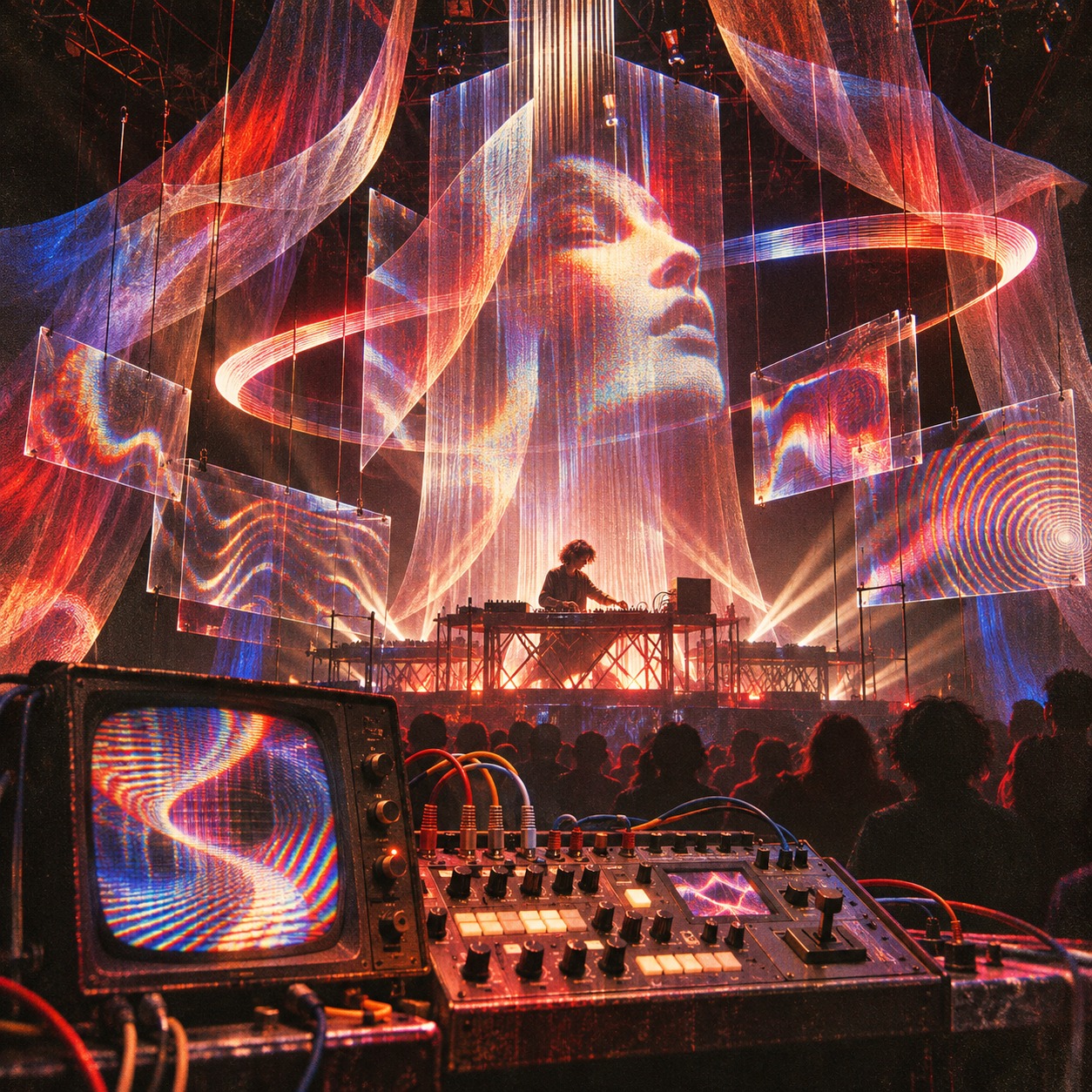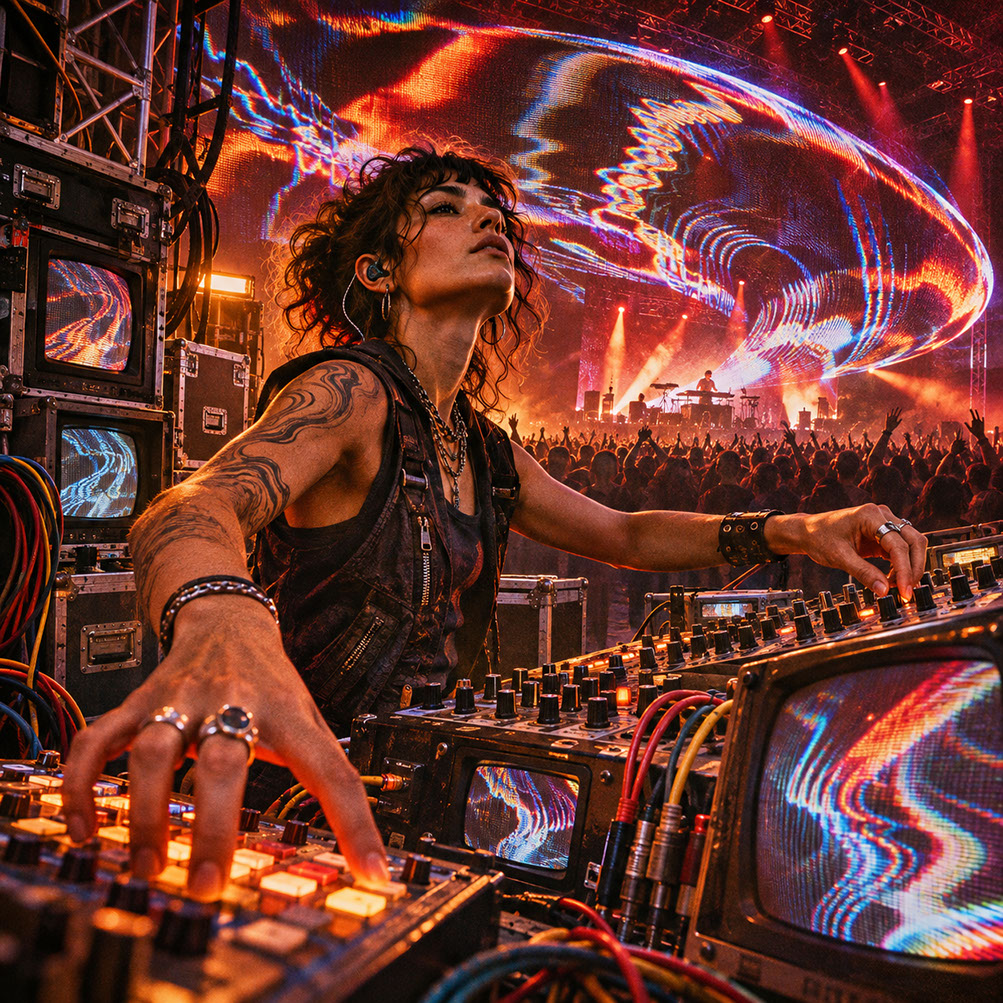
Spatial Stages and Volumetric Crowds: 7 Essential Techniques for Designing Live Visuals for Apple Vision Pro and Beyond
Discover how to design live visuals for both physical festival crowds and spatial headset viewers using Apple Immersive Video and Gaussian Splatting.
 🔍 COVER PLATE — CLICK TO EXPAND
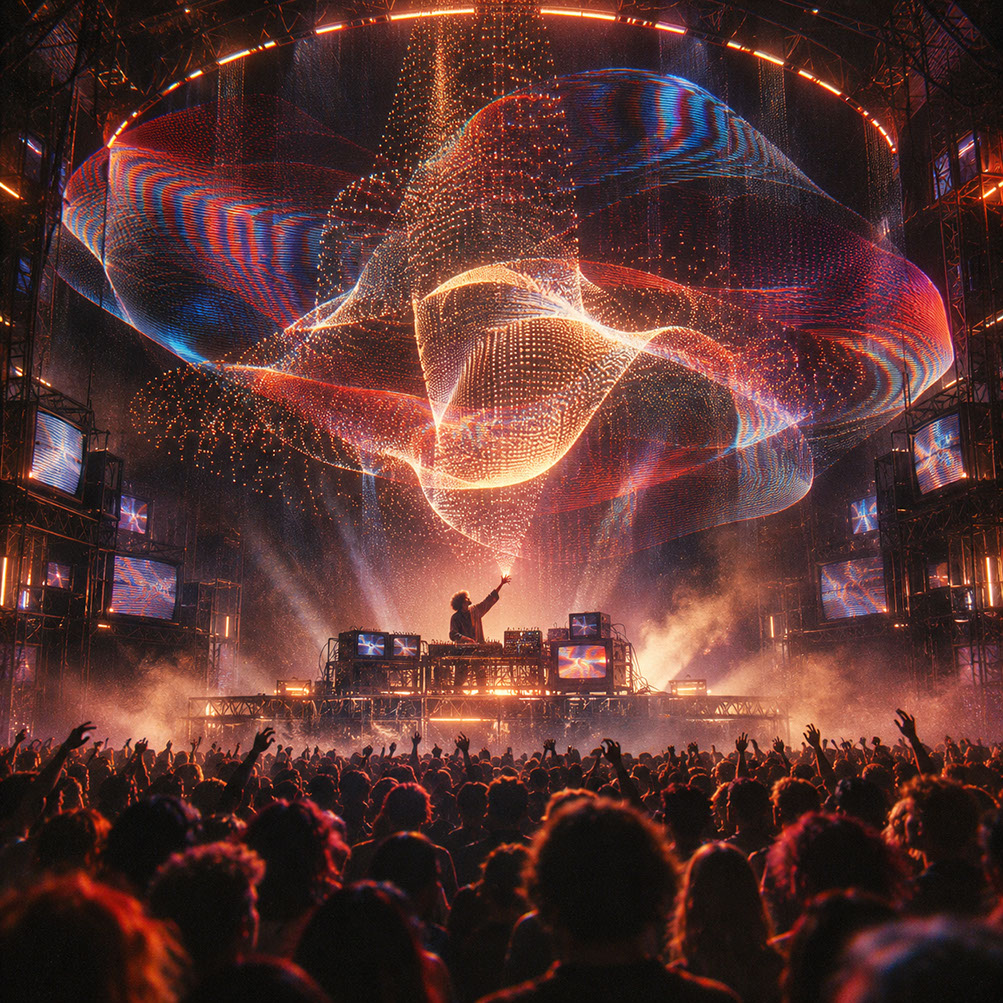
Episode 5 Hero Cover: Designing simultaneous live visual experiences for the physical dancefloor and remote spatial headset audiences.
The next sold-out festival might have two audiences experiencing the same performance in fundamentally different ways—one standing in the field, the other floating through a volumetric recreation from their living room. This is not science fiction. This is happening right now, and if you are a visual artist working in live performance, understanding how to design for both audiences simultaneously is becoming essential knowledge.
The convergence of spatial computing devices, advanced capture technology, and real-time rendering is creating an unprecedented challenge for live visual artists. Major productions are already capturing concerts with spatial broadcast in mind—Metallica's Apple Immersive Video project, captured with 14 cameras, demonstrates the scale of investment industry leaders are making in this medium. Visual artists who understand spatial composition today will lead the market tomorrow.
 🔍 PLATE 01 — CLICK TO EXPAND
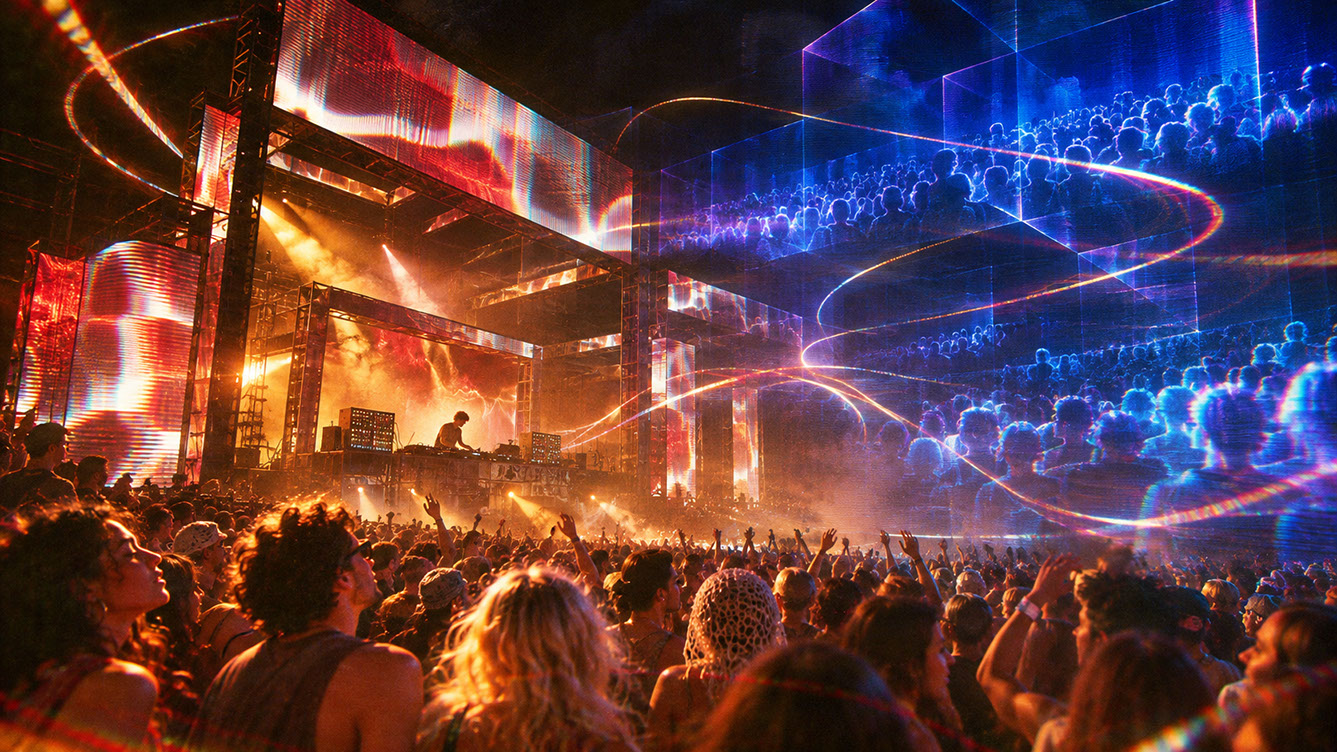
The Venue Floor and the Spatial Headset: Plate 01 (Introduction — Two Audiences): How spatial computing expands live performance beyond the physical walls of the venue.
The Convergence That Changed Everything
So why is this happening now? The answer lies in a perfect storm of technological maturity and commercial investment.
Apple Immersive Video has emerged as a genuine catalyst for change. This format delivers 180-degree stereoscopic 8K capture with Spatial Audio, designed specifically for immersive consumption rather than traditional flat broadcast. The format's requirements fundamentally change how we think about capturing live performance—suddenly, depth matters as much as framing.
Major production houses are not treating this as experimental. High-profile concert projects designed specifically for spatial delivery represent significant production commitments. When you see this level of investment from industry leaders, it signals genuine confidence in the medium's commercial viability.
This creates what I call the dual-audience requirement. Physical attendees expect their experience to remain paramount—they paid for tickets, they deserve the best show possible. Meanwhile, spatial viewers expect more than documentation; they expect presence. They want to feel like they are actually there. Visual artists must now satisfy both audiences simultaneously, which requires rethinking our entire approach to composition and delivery.
The device proliferation timeline adds urgency to this conversation. Spatial computing devices are moving from early adopter territory into broader adoption. The audience for spatial content is growing month by month, and artists who develop fluency in this medium now will have a significant competitive advantage.
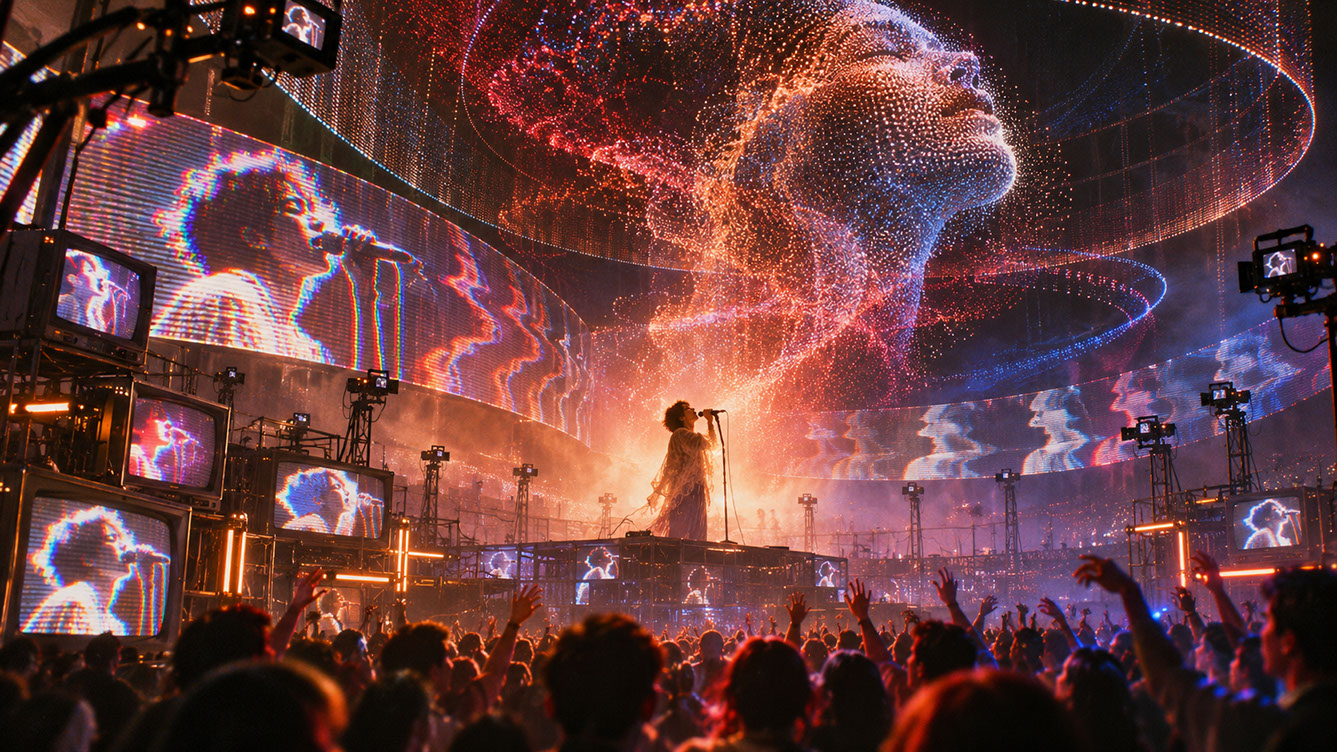 🔍 PLATE 02 — CLICK TO EXPAND
Plate 02 — The Convergence That Changed Everything — Spatial Headsets, 8K 3D Capture & Real-Time Engines: Plate 02 (The Convergence That Changed Everything): High-resolution micro-OLED headsets and neural scene reconstruction turning broadcasts into inhabited spaces.
Understanding Apple Immersive Video as a Capture Format
Let us get into the technical foundation. Apple Immersive Video captures a 180-degree field of view with stereoscopic depth, requiring 8K resolution to maintain spatial fidelity when viewers look around within the scene. Spatial Audio integration means sound placement becomes three-dimensional, with instruments and audience noise positioned accurately in space around the viewer.
This differs dramatically from traditional concert capture. There are no editorial cuts—the viewer chooses their own gaze direction. You cannot force them to look at the guitarist during the solo; you can only invite them. Depth becomes as important as framing, and the entire visible environment becomes your canvas.
For visual designers, this has profound implications. Graphics must exist in depth, not just on flat planes. Attention guidance works entirely differently without editorial control. Visual density must be considered in all directions—what happens when someone looks up, or behind them, or focuses on an unexpected corner of the stage?
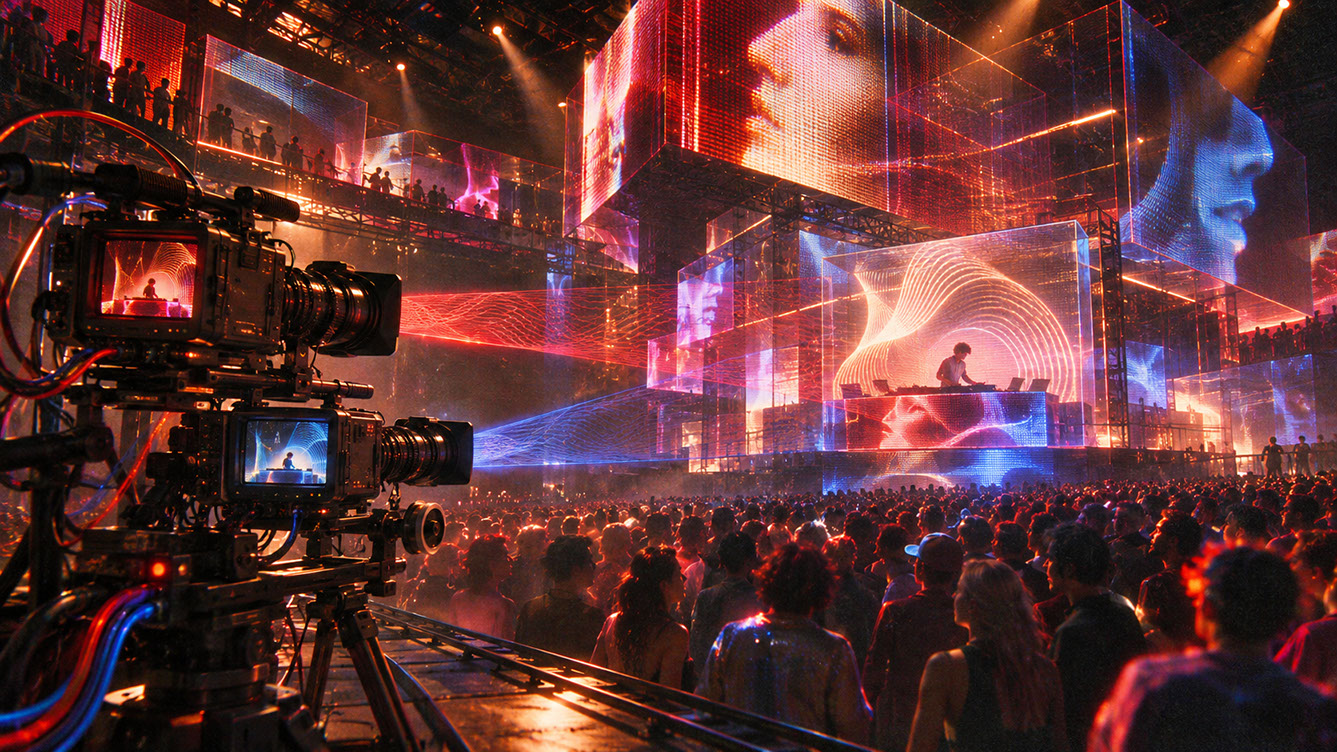 🔍 PLATE 03 — CLICK TO EXPAND
Plate 03 — Understanding Apple Immersive Video — 180-Degree 8K 90fps Stereoscopic Stage Capture: Plate 03 (Apple Immersive Video Capture): Managing dynamic range, LED refresh rates, and stereoscopic comfort zones for 90fps spatial playback.
Gaussian Splatting for Live Venues: Promise and Reality
Gaussian splatting has generated considerable excitement in the volumetric capture community, and rightfully so. This technique offers real-time novel-view synthesis capabilities—essentially, the ability to generate new camera angles from captured data in real time. Original research demonstrates 1080p at 30+ FPS under controlled conditions, suggesting the potential for free-viewpoint concert experiences where viewers can move through the performance space at will.
However, we need to be honest about the gap between research conditions and live production reality. Research demonstrations typically use prepared scenes—static environments with controlled lighting and predictable geometry. Live concerts are the opposite: dynamic environments with constantly changing lighting, moving performers, audience members in unpredictable positions, and stage elements that confuse reconstruction algorithms.
Network transport at scale presents additional challenges. Processing latency, quality trade-offs for real-time performance, and the infrastructure requirements for synchronised multi-camera capture all create practical hurdles.
That said, the near-future trajectory looks promising. By 2027, we are likely to see hybrid approaches combining pre-captured environments with live performer elements—essentially, building the venue and stage as static volumetric assets, then integrating live performer capture in real time. This balance between ambition and reliability will define early spatial concert production.
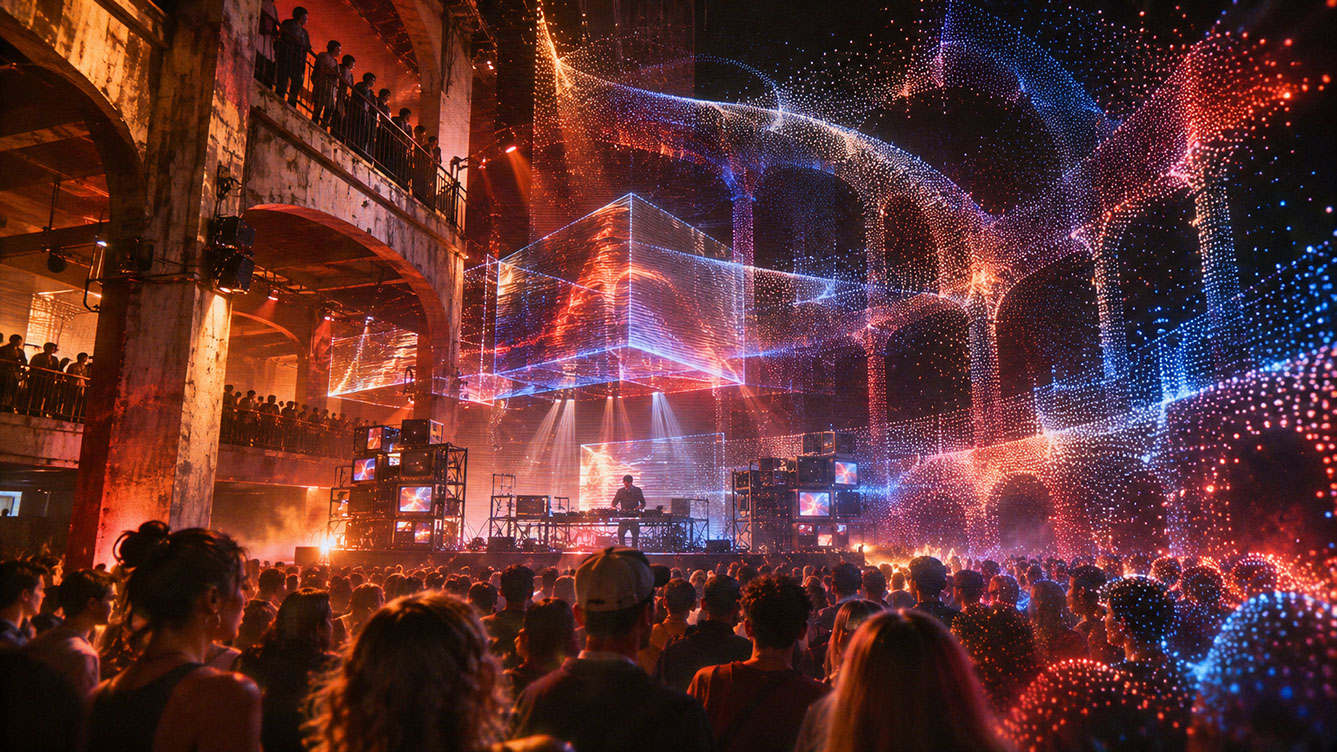 🔍 PLATE 04 — CLICK TO EXPAND
Plate 04 — 3D & 4D Gaussian Splatting for Live Venues — Photorealistic Radiance Fields in Motion: Plate 04 (Gaussian Splatting for Live Venues): Capturing atmospheric haze, specular reflections, and six-degrees-of-freedom stage viewpoints.
Volumetric Capture Infrastructure Considerations
Building a volumetric capture pipeline for live events requires attention to several technical domains.
Multi-camera synchronisation demands frame-accurate capture across numerous viewpoints. Genlock and timecode requirements become critical—even a few frames of drift between cameras can destroy reconstruction quality. Consistent exposure and colour across all cameras presents ongoing challenges, particularly in venues with dynamic stage lighting.
Tracking and calibration requirements are similarly demanding. Camera position accuracy affects reconstruction quality directly. Real-time calibration differs significantly from post-processed approaches, and environmental factors—vibration, temperature changes, even audience movement—can affect tracking reliability throughout a show.
Processing pipeline options range from real-time reconstruction to post-capture processing. Real-time approaches enable live spatial broadcast but sacrifice quality. Post-capture processing delivers higher fidelity but eliminates the live broadcast option. Understanding when each approach makes sense depends on your specific production requirements and audience expectations.
Live environment challenges include changing lighting affecting capture quality, audience and crew movement in capture zones, and stage elements—particularly reflective or transparent materials—that confuse reconstruction algorithms.
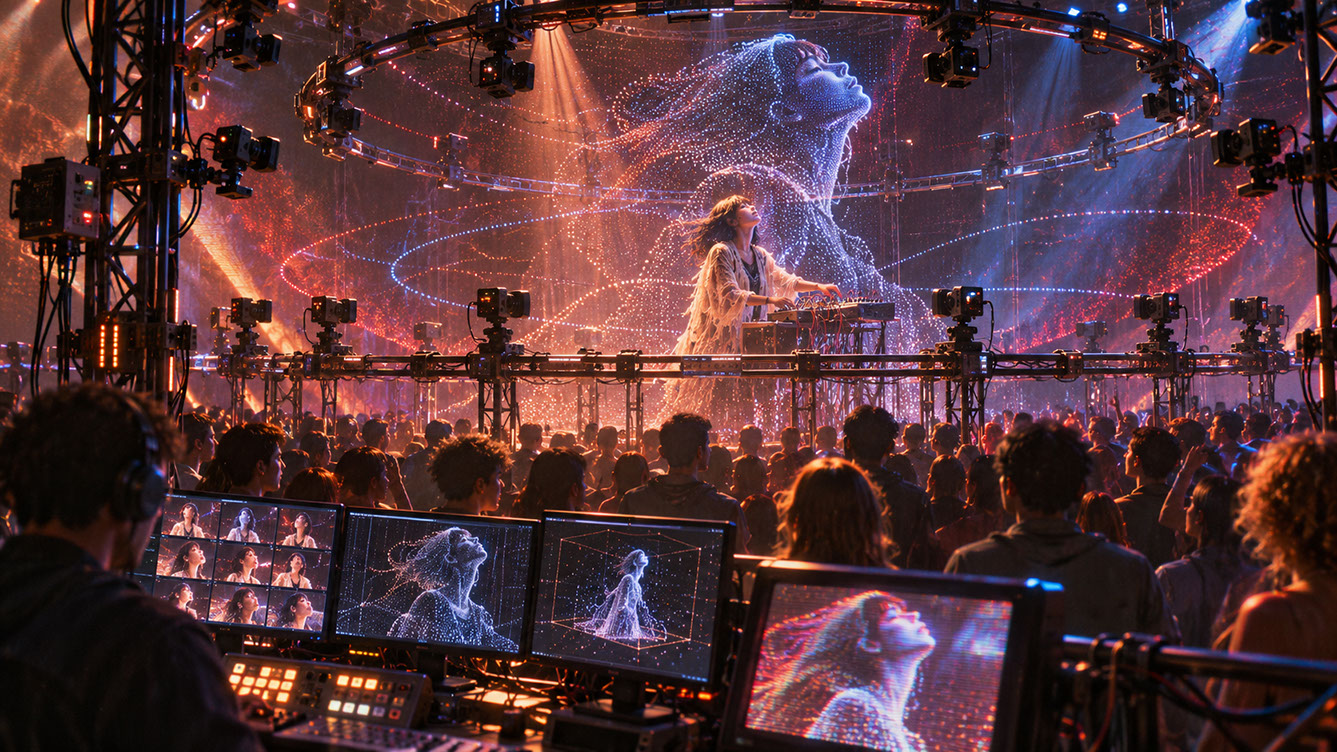 🔍 PLATE 05 — CLICK TO EXPAND
Plate 05 — Volumetric Capture Infrastructure — Multi-Camera Genlock, LiDAR Depth & Fiber Backhaul: Plate 05 (Volumetric Capture Infrastructure): Practical rigging, genlock synchronisation, and data bandwidth engineering for live venue capture.
Building the Dual-Delivery Pipeline
Let me share a practical signal flow for spatial broadcast:
Multi-camera capture flows through synchronisation and tracking systems, then into volumetric reconstruction or Gaussian splat processing, through Unreal Engine or Unity for scene composition, and finally to spatial broadcast and headset output.
Meanwhile, your physical audience pipeline follows a different path: stage tracking feeds into your Unreal or TouchDesigner scene, camera and frustum logic shapes the composition, and outputs route to LED walls and projection systems.
The key is building a shared data layer between these pipelines. Performance timing should be shared between deliverables. Colour logic remains consistent across outputs. Audio-reactive parameters drive both systems from the same source data. The same performance language, expressed through different delivery mechanisms.
Unreal Engine or Unity serves as your central rendering hub, with scene data exported to multiple formats simultaneously. Live parameter control affects both outputs, ensuring the artist's performance translates consistently whether someone is watching from the pit or their living room.
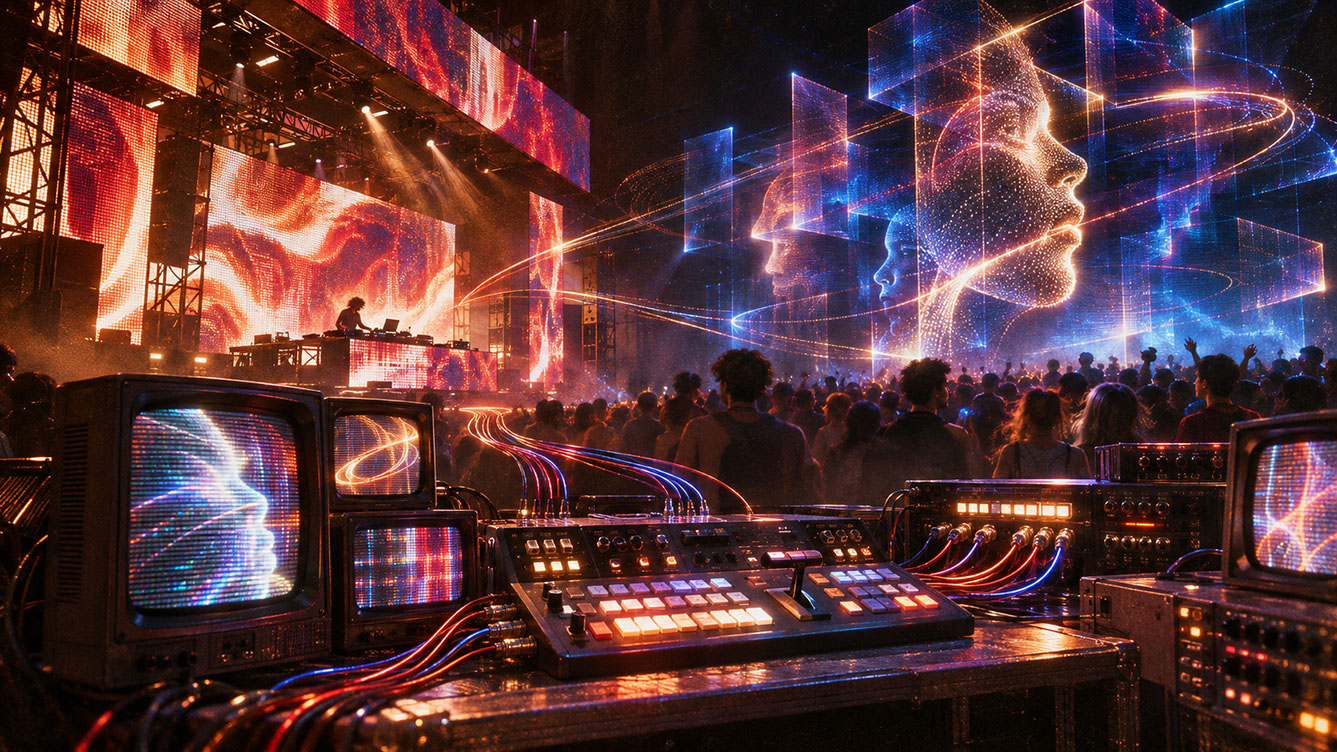 🔍 PLATE 06 — CLICK TO EXPAND
Plate 06 — Building the Dual-Delivery Pipeline — One Real-Time Scene Graph Feeding LED Walls & Spatial AR: Plate 06 (Dual-Delivery Pipeline): Rendering both physical LED processor maps and volumetric spatial overlays from a unified real-time engine.
Aesthetic Language for Spatial Design
Designing for spatial viewing requires fundamentally different compositional thinking.
First, design for discovery. Create elements that reveal themselves from different angles. Build layered depth that encourages exploration. Avoid compositions that only work from one position—if your visual only makes sense from centre stage, it will fail for spatial viewers who explore the scene.
Treat depth as a primary design element. Negative space becomes navigable volume. Particles should occupy three-dimensional space, not just spray across a flat plane. Lighting should reveal form rather than flatten it—think sculptural rather than graphic.
Guide attention without editorial control. Use motion, colour, and sound to create focal points that work from multiple viewpoints. Accept that different viewers will literally see different shows depending on where they choose to look. This requires a certain letting go of directorial control that can feel uncomfortable at first.
Avoid flat graphic compositions. Traditional VJ graphics—text, logos, 2D animated elements—often lose meaning when viewed from angles. Volumetric thinking must begin at the concept stage, not as a retrofit. Test your compositions from unexpected viewpoints early and often.
Critically, spatial design must not diminish the physical crowd experience. Finding compositions that serve both audiences requires careful balance. Know where compromise is necessary and where it is not—the in-person experience remains your primary deliverable for most productions.
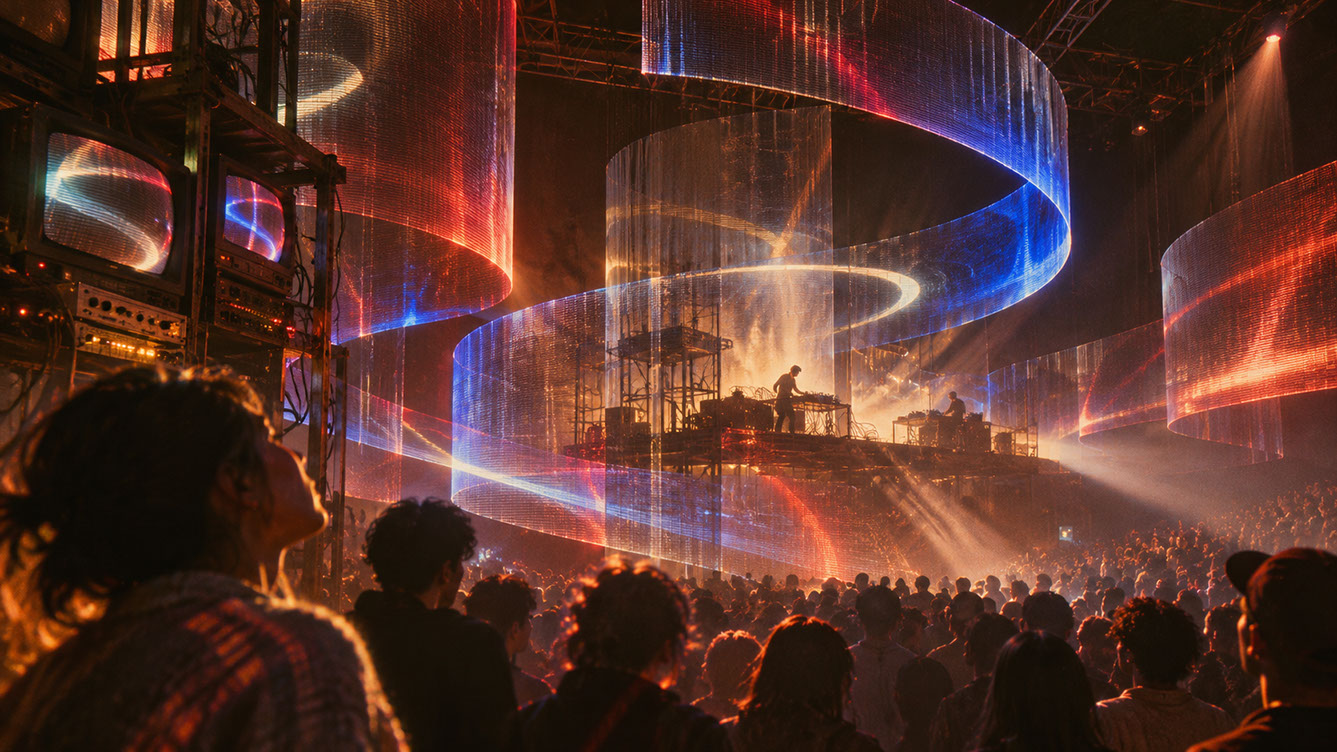 🔍 PLATE 07 — CLICK TO EXPAND
Plate 07 — Aesthetic Language for Spatial Design — Parallax Depth, Scale & Vestibular Comfort: Plate 07 (Aesthetic Language for Spatial Design): Choreographing Z-depth parallax and horizon anchors that thrill spatial viewers without inducing motion sickness.
Practical Workflow: Dual Deliverables from Day One
The most important workflow advice I can offer: build for both outputs from the beginning, not as an afterthought.
Develop physical-stage and headset compositions in parallel. Share source assets but optimise for each format specifically. Maintain clear version control for divergent deliverables—you will thank yourself during revision cycles.
Identify which elements are format-specific and which are universal. Timing, colour logic, and audio reactivity should be universal. Camera frustum and composition framing are format-specific. Avoid forcing identical framing across formats—what works on a flat LED wall may fail in volumetric space.
Test spatial compositions from multiple viewpoints early in development. Identify elements that fail from unexpected angles before you commit significant production resources. Iterate before you are locked into expensive capture sessions.
Document everything clearly. Note which elements are format-specific. Establish clear communication protocols with capture and post-production teams. Create explicit asset handoff procedures—spatial production involves more collaborators than traditional live visuals, and clear documentation prevents costly misunderstandings.
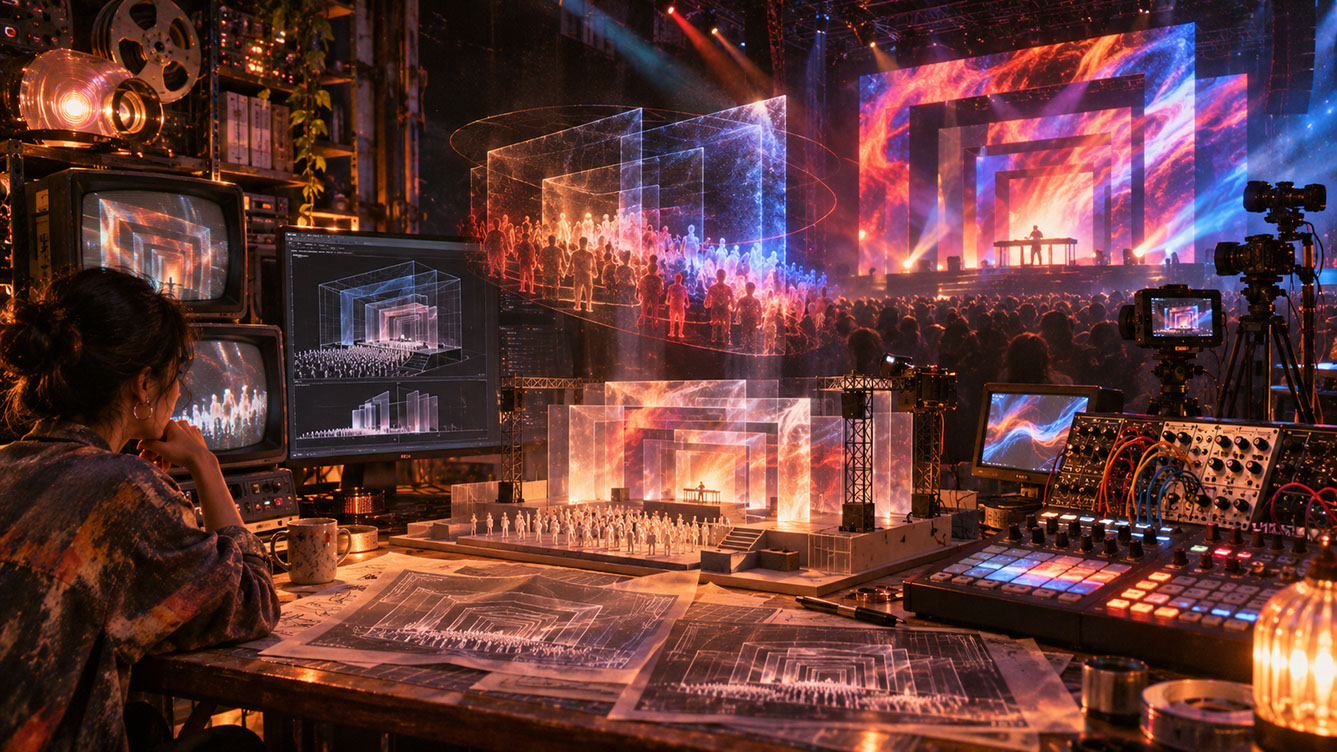 🔍 PLATE 08 — CLICK TO EXPAND
Plate 08 — Practical Workflow — Authoring Spatial-Ready 3D Assets and Timecode Stems from Day One: Plate 08 (Dual Deliverables from Day One): Structuring pre-production assets and timecode logs so spatial releases require zero post-show rebuilding.
Cross-Disciplinary Skills Adaptation
For musicians, spatial capture extends performance staging beyond passive documentation. Your movement and positioning directly affect the spatial viewer's experience. Collaborate with spatial designers during show development—your stage presence is now a compositional element.
For 3D artists working in Cinema 4D, Blender, or similar tools, the transition involves adapting assets into optimised real-time geometry. Understanding polygon budgets for real-time spatial rendering becomes essential. Develop LOD (level of detail) strategies for varying viewer distances—objects that look perfect at three metres may need different geometry at thirty metres.
For compositors, the shift involves learning camera position, occlusion, and parallax considerations. Depth compositing replaces flat layer stacking. The fundamental shift is from frame-based to volume-based thinking—you are no longer creating pictures, you are building spaces.
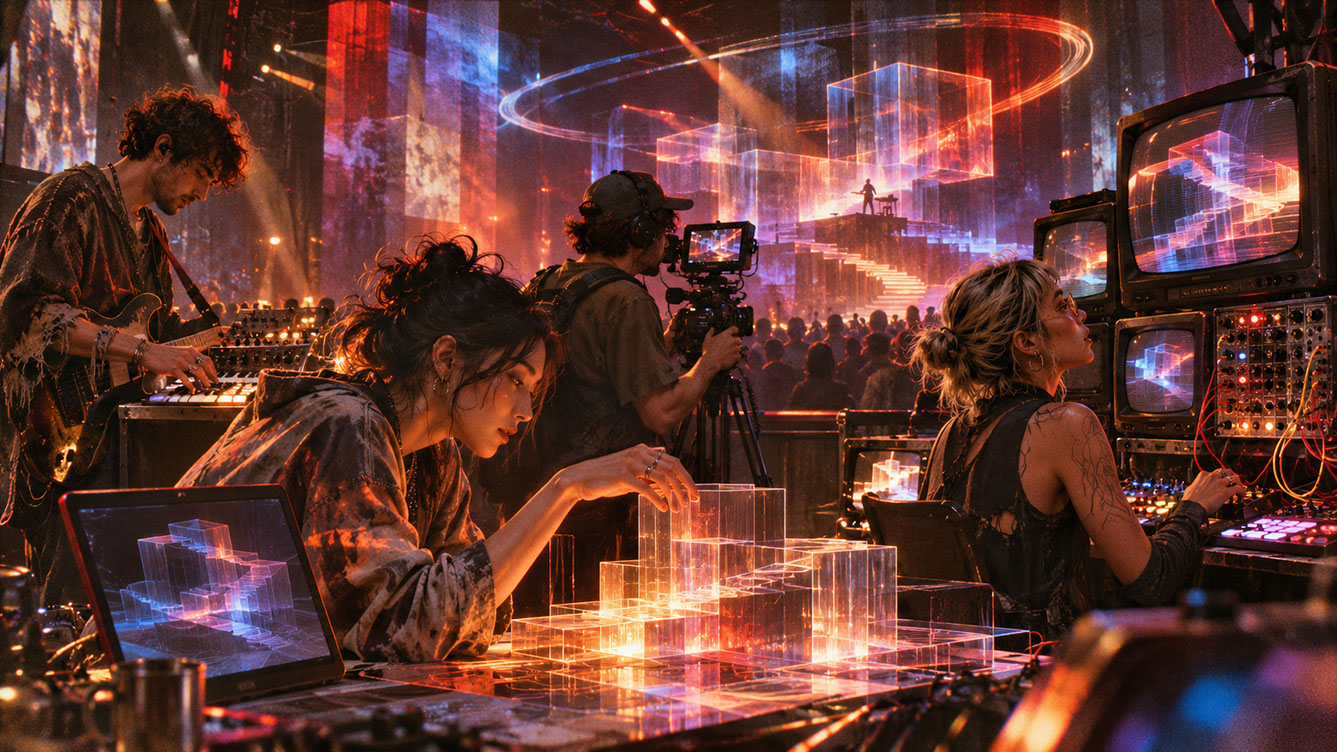 🔍 PLATE 09 — CLICK TO EXPAND
Plate 09 — Cross-Disciplinary Skills Adaptation — Uniting VJs, Game Environment Artists & Dolby Atmos Mixers: Plate 09 (Cross-Disciplinary Skills Adaptation): Bridging live VJ timing with game-engine optimisation and spatial audio localisation.
Conclusion
Spatial computing is creating genuine dual-audience requirements for live visual performance, and this is not a distant future concern—it is happening now. Understanding capture formats like Apple Immersive Video has become essential knowledge for visual artists working at professional levels.
Gaussian splatting offers exciting future potential, but current production largely relies on more established volumetric approaches. Designing for viewpoint changes requires rethinking composition from the concept stage, not retrofitting flat graphics into three-dimensional space.
Most importantly, building dual deliverables from day one prevents costly retrofitting later. The artists who develop spatial fluency now will define how live performance looks in 2027 and beyond.
Begin testing compositions from multiple viewpoints today, even without spatial capture equipment. The compositional thinking transfers to any tool you eventually adopt. Your future self will thank you.
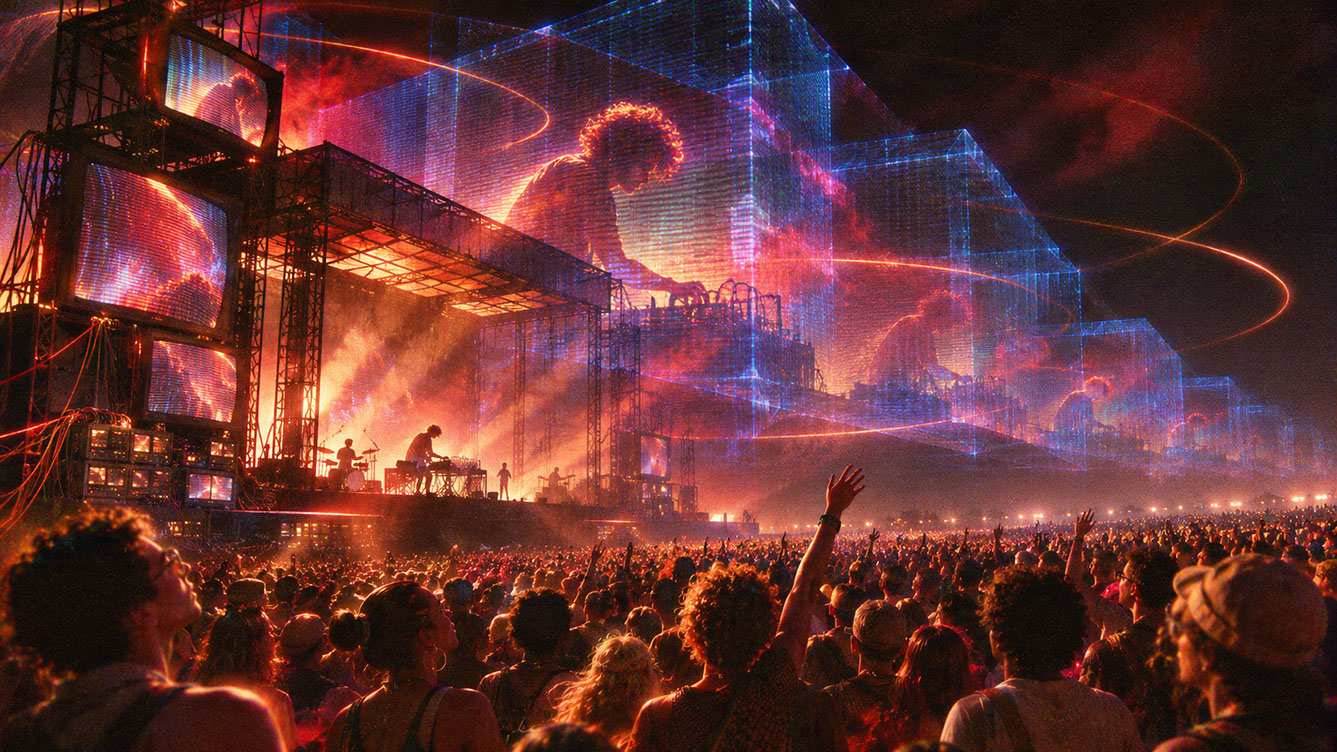 🔍 PLATE 10 — CLICK TO EXPAND
Plate 10 — Conclusion — The Boundaryless Stage Uniting Physical Energy and Spatial Presence: Plate 10 (Conclusion): Expanding the emotional reach of live visual performance into the spatial computing era.
⚡ 5 Strategies to Consider
STUDIO PLAYBOOK // 5 DIRECTIVES❓ Frequently Asked Questions — 5 Q&As (5 Q&As)
SCHEMA.ORG/FAQPAGE // 5 Q&As (5 Q&As)Q1. What equipment do I need to start experimenting with spatial visual design?
Begin with existing 3D software like Blender or Cinema 4D and real-time engines such as Unreal Engine or Unity. An Apple Vision Pro or similar spatial computing device is valuable for viewing tests. Multi-camera volumetric capture requires significant investment, but spatial composition principles can be learned and practised with standard tools before scaling up to full production pipelines.
Q2. Will spatial concert broadcasts replace physical attendance at live events?
Unlikely. Spatial viewing offers a different experience rather than a replacement for physical presence. The social connection, environmental atmosphere, and embodied aspects of live attendance remain unique and irreplaceable. Spatial broadcast expands audience reach to those who cannot attend physically rather than cannibalising existing ticket sales.
Q3. How do I balance visual quality between physical and spatial outputs?
Prioritise neither at the expense of the other. Design from shared principles—timing, colour logic, and audio reactivity—then optimise each deliverable specifically for its medium. Accept that some visual elements will work better in one format than the other, and design with this flexibility in mind from the beginning.
Q4. What is Apple Immersive Video and why does it matter for live visuals?
Apple Immersive Video is a capture format delivering 180-degree stereoscopic 8K video with integrated Spatial Audio, designed for immersive consumption on spatial computing devices. It matters because it fundamentally changes capture philosophy—viewers choose their own gaze direction rather than following editorial cuts, requiring visual designers to think about composition in three dimensions.
Q5. What is Gaussian splatting and is it ready for live concert production?
Gaussian splatting is a technique for real-time novel-view synthesis, enabling generation of new camera angles from captured data. While research demonstrates promising results under controlled conditions, live concert environments present significant challenges including dynamic lighting, moving performers, and processing latency. Hybrid approaches combining pre-captured environments with live elements are more practical for 2027 productions.
EXPLORE RELATED STUDIO TAGS (6):
Glad this piece sparked something — want the matching 4096×4096px .ZIP pack?
Enter your email below for an instant direct download of Studio Seamless Pattern Pack — Drop 01 (WPAY_DROP01.zip) plus new Studio Journal essays & free drops.